[See also May '11 post, "Jerusalem with Melissa"]
 Jerusalem is one of the world's great cities, with an amazing history. It has been destroyed and rebuilt at least 20 times. One of those times was in 586 BCE -- soon after Lehi and his family left for the New World, as described in the first chapters of the Book of Mormon. In our Center hangs this painting depicting that event. Lehi's departure in 600 BCE was followed by the Babylonian siege and total destruction of the city.
This model at our Center shows Jerusalem prior to the 586 destruction. See City of David (bottom left), Temple Mount (rt.), expanding city to the west within walls built by King Hezekiah to fend off invasion by Assyria in 70 1 BCE, and his tunnel to Pool of Siloam (bottom left).




.JPG)
Atop that cliff and beneath the visitors center were ruins some scholars think was David's palace. From there, he could have spied Bathsheba's rooftop.


 To protect against the Assyrians in 701 BC, King Hezekiah had a 1/2 mile-long-tunnel built -- to transport water from Gihon Spring inside the city walls & to supply the expanding city. Amazingly, workers at both ends chiseled into solid rock, in the dark, and met at exactly the same point.


On 10/17/11, I went alone with Eric Huntsman's class -- but through the even older Canaanite dry tunnel, built before David's time for carrying water from Gihon to Jerusalem. It was just as narrow but well lit and much shorter (360' long).


Ascending with Aubrey (who took the dry tunnel to avoid a panic attack in the dark wet tunnel), we found more profusely blooming buganvilias.


Passing these murals, we entered Herod's long upward tunnel. This was a storm drain just below street level, to carry runoff to the Pool of Siloam.


Walking back down towards Gethsemane, we saw these Hasmonean tombs at the Mt. of Olives base -- ostensibly for Zechariah & Absalom.


This beautiful area is crowned by the Russian Church of Mary Magdalene.


 Jerusalem was rebuilt by the Muslims between 638 and 1600 CE. Today's Old City on our JC model shows the Temple Mt. in the middle, Muslim Quarter above (rt.), Jewish Quarter (left), Arminian Quarter (upper left) & Christian Quarter (upper rt.) -- all far above original city levels. Today, City of David ruins rest outside the city walls (bottom far left).
 This 1839 dagerrotype in my office shows Jerusalem just before 1841 Holy Land dedication by apostle Orson Hyde for the gathering of Abraham's seed.
 Our first visits to the Old City were to several charitable societies in the Christian Quarter--but serving all comers. (See Sept. '10 post, "Humanitarian Outreach".)


 Jerusalem is one of the world's great cities, with an amazing history. It has been destroyed and rebuilt at least 20 times. One of those times was in 586 BCE -- soon after Lehi and his family left for the New World, as described in the first chapters of the Book of Mormon. In our Center hangs this painting depicting that event. Lehi's departure in 600 BCE was followed by the Babylonian siege and total destruction of the city.
 This model at our Center shows Jerusalem prior to the 586 destruction. See City of David (bottom left), Temple Mount (rt.), expanding city to the west within walls built by King Hezekiah to fend off invasion by Assyria in 70 1 BCE, and his tunnel to Pool of Siloam (bottom left).


On 10/11/10, we accompanied Frank Judd's class to see Jerusalem's very earliest ruins. We returned there on 10/17/11 with Eric Huntsman's class.


The City of David's symbol -- his lyre, was on the front gate. He captured Jerusalem from the Jebusites in 1,000 BC, as his empire's new capital. The weather was perfect -- also the blooming flowers.


Our tour started in the visitors center with a 3D film detailing Jerusalem's long & storied history. Today, Ir David is a major archaeological park


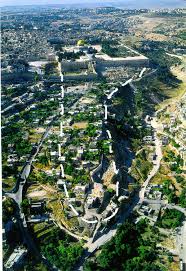
Dashed lines in the aerial shot below overlie today's village structures.

As the model shows (above right), the original ruins ran down the mountain south of today's Old City walls. They were built below the Temple Mount because the abundant water supply was at the lower Gihon Spring.


From this high lookout, the still-deep Kidron Valley and Mount of Olives were covered with both modern and ancient Jewish graves.


Starting at the Mt. of Olives base to the east, the densely populated Silwan (Arabic for Siloam) and other Arab towns run up that sacred hill. The City of David was built on sheer cliffs along the opposite (west) side of Kidron Valley


Wrapping around us to the SW was the visitors center many small structures filling in the original, smaller Hinnom Valley.

Tunneled into the cliff are these ancient royal tombs -- the only ones not on the Mt. of Olives. Perhaps they were those of David & Solomon -- since they alone were said to have been buried in the City of David (1 Kings 2:19, 11:43).
.JPG)


Beneath the ruins is an extended stepped-stone retaining wall, built to support a very high and mighty structure -- possibly, King David's palace.

 To protect against the Assyrians in 701 BC, King Hezekiah had a 1/2 mile-long-tunnel built -- to transport water from Gihon Spring inside the city walls & to supply the expanding city. Amazingly, workers at both ends chiseled into solid rock, in the dark, and met at exactly the same point.
We saw remnants of Gihon Spring's ancient fortifications.


On 10/11/10, we descended into the deep, dark Hezekiah's Tunnel along narrow walls (18 to 24" in spots) that were at times less than 5' high but rose to 20 ' toward the end -- partly following an ancient crevasse. Soon we felt the water at our ankles, then at our knees, then beyond. Students sang: "Give, Said the Little Stream" and "Lead Kindly Light."


We are still smiling, although the water is above our knees. Daily high waters levels were shown on a cartoon board at the start of our underground adventure.


On 10/17/11, I went alone with Eric Huntsman's class -- but through the even older Canaanite dry tunnel, built before David's time for carrying water from Gihon to Jerusalem. It was just as narrow but well lit and much shorter (360' long).


Ascending with Aubrey (who took the dry tunnel to avoid a panic attack in the dark wet tunnel), we found more profusely blooming buganvilias.


Anciently, water from Gihon Spring emptied into the Pool of Siloam. In Byzantine times, this narrow pool was thought to be that site -- where the Huntsmans & our students exited from the wet tunnel.


In fact, the pool was large enough to provide the city's basic water supply for many years, as depicted on this beautiful wall mural nearby.


The actual site of Siloam has been recently discovered & partially excavated. There, Jesus' own divine powers healed a man blind since birth, using only the crude elements of spittle, mud & dirty water (John 9).


Dr. Huntsman noted that this miracle came during the Feast of Tabernacles, when priests sacrificed remaining pool water at the temple and prayed for more rain. Jesus used water and mud (mortality), combined with spirit, to bring light to the blind -- while chiding the priests' works in darkness.


Siloam's unexcavated portion beyond the fence was much larger.


These murals depicted the priestly temple "water procession" from Siloam.


Some sections required as much stooping as the wet tunnel. On surfacing at the Temple Mount, we saw how the Tyropoean Valley has filled in with the debris of centuries.


Several students & I entered the Zacharias monument, not knowing what to expect.


Inside were a series of rooms, each with tombs carved into the bedrock.


We fled in time to catch the bus, with one last look down the Kidron Valley. I hope to explore these ancient tombs again.


________________________________________
 Jerusalem was rebuilt by the Muslims between 638 and 1600 CE. Today's Old City on our JC model shows the Temple Mt. in the middle, Muslim Quarter above (rt.), Jewish Quarter (left), Arminian Quarter (upper left) & Christian Quarter (upper rt.) -- all far above original city levels. Today, City of David ruins rest outside the city walls (bottom far left).
 This 1839 dagerrotype in my office shows Jerusalem just before 1841 Holy Land dedication by apostle Orson Hyde for the gathering of Abraham's seed.
  Our first visits to the Old City were to several charitable societies in the Christian Quarter--but serving all comers. (See Sept. '10 post, "Humanitarian Outreach".)
We usually enter the Old City thru the modern Jaffa Gate.


We follow narrow, winding streets past countless shops.


There are some great places to eat--like David's.


Thanks for the historical perspective of Israel. You are educating all of us. We applaud your humanitarian efforts, also. Great example. Have a great week. Love, Sue and Dave
ReplyDelete