During Field Trips with students on 3/30/11 and 11/30/11, we visited Old City Christian churches built after 325 AD. Marilyn was sick with a high fever so missed it on 3/30/11. [See Nov. '10 post, "More Muslim, Jewish and Christian Events," Dec. '10 posts, "Last Days of Jesus" & "Ascension Churches of Jerusalem"]
Terra Sancta Monastery. This distinctive church is clearly visible from our JC, just inside New Gate along the NW Old City walls.

Dr. Jeff Chadwick called it the most beautiful chapel in the Old City. It was built in early 1800s by Franciscan friars on a much earlier Crusader site (12th century). Franciscans in the order of St. Francis of Assisi (died 1226 AD) followed rules of St. Benedict (died 547 AD), incl. vows of poverty, chastity & obedience -- shown by 3 knots in tie ropes on their robes. Franciscan fellowship is shown by their symbol of clasped arms.


On 3/30/11 Father Carlos Molina, a Franciscan monk from Argentina, was our guide and also played the pipe organ for us.


Oldest items (12th Cent.) were the altar & choir stalls behind Dr. Jackson.


Of special LDS interest was the name "Hyde" carved into a courtyard door, where Dr. Chadwick pointed. This was a hostel where Orson Hyde may have stayed when he dedicated the Holy Land in Oct. 1841 for the gathering of Israel.


Laundry, sewing, food & other support facilities were there in 1841, incl. the 1st pharmacy in Jerusalem. Fr. Molina held the pass key to a 12th Cent. iron door.


We sang "All Creatures of our God and King" before departing.


On 11/30/11 the church was in Christmas decor. In front was this advent wreath & purple banner -- denoting the newborn King of Kings. One of the 4 bottles of red oil was burned each week before Christmas.


By the entry door was a Nativity scene -- with the manger set covered by a wide burlap strip until Christmas Eve.


The church walls included some lovely small chapels & artwork.


This was a finely-crafted hardwood confessional booth.

Every Catholic church depicts the 14 numbered "Stations of the Cross," culminating in the resurrection of Christ on Easter Sunday.


St. Saviour's Church. This one was not seen on either field trip. But on 10/27/11 we attended an organ recital at this church, close toTerra Sancta. It was finished in 1885 by Austrian Emperor Franz Joseph.


A young Ukranian Jew (Roman Krasnowsky) played some impressive Bach, Franck & other pieces on a gorgeous instrument. That was part of an annual series of organ programs promoted by the Magnificat Institute (affiliated with Terra Sancta) -- the only school of music in the Old City.


On 11/27/11, the Magnificat brought a 40-voice Yasmeen Choir (33 girls, 7 boys) to our JC. They sang English & Palestinian "Christmas Carols" -- before and after 2 "Excelling Young Artists" played piano & organ.


St. Mark's Syrian Orthodox. This was built where the home of John Mark's mother may have been the first Christian church in Jerusalem (Acts 12:12) -- destroyed by Romans in 70 AD. Here, Jesus may have appeared after resurrection, the apostles replaced Judas & received the Holy Ghost on Pentecost.


Our host Christina was a bit cranky on 3/30/11, as she had expected our large group to come in the afternoon. (No photos were allowed there; these were online.) She told of her 3 miracles while there for 11 years (gift of tongues, healing & vision of Jesus in glory). She also sang The Lord's Prayer in Aramaic.


The lower level had remains from 1st Century, Byzantine & Crusader periods. (Photos were OK there.)

An icon upstairs, said to have been painted by St. Luke (with golden halos & hands added later), was replicated and displayed downstairs.


Old City Streets. While en route to St. Mark's Church, we passed a Catholic Scout HQ. Jared Maxfield, an avid scouter, got a photo-op.


At 9:30 am, shopkeepers were just unlocking their heavy metal doors.

Soon there were colorful shop displays everywhere.


The pita ("pocket bread") factory. Always good! I also bought some of their tasty meat pies.


St. John the Baptist Church. This Greek Orthodox church, with its silvery dome, was closed during both tours. It may be the oldest church in Jerusalem (started 5th Cent. AD) and was the 1st hospital for which Crusader knights hospitallers were named.
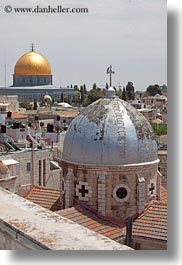


On 8/30/11 we returned with the new faculty and found it was open.

The church's interior has been restored but is on the original foundations.


The oldest part was the lower vaulted crypt, rebuilt by Crusaders in the 11th century and hardly changed in the last 1,000 years.


Lutheran Church of the Redeemer. To give German Lutherans a presence in the Old City, the Ottoman Empire granted ally Kaiser Wilhelm II part of the Muristan (Persian for "hospital") to build this in 1869. (Note BYU's JC on Mt. Scopus just beyond the 1898 bell tower -- tallest structure in the Old City.)


Crusader-era hallways & chapel were built around landscaped cloisters.


The Crusader chapel was also ready for the Christmas season. The advent wreath had 4 blue candles -- one lit for each week before Christmas. On Christmas Eve, a white one is lit in the center.


This was more recent Lutheran chapel -- also quite small. Kerry & Julianne Muhlstein also enjoyed the 3/30/11 visit.


Next to this church was today's Muristan -- an Arab souq with many shops.


The fountain complex was Muristan's hub. Shops radiated outward.


We continued on to our next adventure at another nearby church.


Inside were remnants of Hadrian's Cardo & temple gate (135 AD).


Dr. A. Skinner connected the archaeology of these ruins with holy sites.

Especially interesting was the Judgment Gate threshold (John 18).

Herodian stones nearby were from 2nd temple period, destroyed 70 AD.

This adjoining narrow passage, with more Herodian stones, has been erroneously called the "eye of the needle" (Matt. 19:24).


Bells are rung for services and special occasions.


In the vestry a nun prayed for names of deceased on a prayer roll.


Beyond this impressive vestry mural was a small ornate chapel, devoid of seating. Worshippers in all Orthodox churches stand during services.

Elaborate, gilded artwork in these churches was used to denote heaven.


The chapel had exquisite paintings of the atonement and resurrection.


We left with a sense of awe and respect for these devoted Christians.


Church of the Holy Sepulcher. [See May '11 post, "Jerus. with Melissa"] Finally, we visited the holiest of all churches to over 1 billion Roman Catholic & Orthodox believers (Greek, Armenian, Coptic, Ethiopian & Syrian) -- venerated as the site of Jesus' death, burial & resurrection. Its two silvery domes were more visible from afar than within the Old City -- situated between Lutheran Church of Redeemer (left) & Terra Sancta (rt.) [Photo from Hurva Synagogue.]


This is how it looked from the JC -- just below the King David Hotel, near the Church of Redeemer tower (left), above Old City walls.

The large complex had a single entry. In the 1808 & 1840 fires, many were trampled trying to exit the church. Saladin closed the 2nd entrance and it has never been reopened.


Because of a status quo agreement (1852) imposed on governing churches by the Ottomans, nothing can be changed in "common territory" w/o 100% consent. In the 1850s, a rooftop ladder was left at the front entry. It is still there today.


This floor plan shows its piecemeal construction -- started by Constantine's mother Helena in 325 AD over the site of Hadrian's temple. Persians damaged it in 615 AD. Its total destruction in 1009 AD helped trigger the Crusades. Since then it has been rebuilt, renovated & changed hands many times.

Beyond the front entry were the anointing stone, wall mural, upper balconies & small dome. A few steps further revealed the balcony at Golgatha.


Stairs right of the front entry ascended to the rock of Golgatha.


Pilgrims knelt to kiss the stone where a hole marked the place of the cross.

The stone was cracked and, by tradition, the blood of Christ dripped onto the remains of Adam interred in the Chapel of Adam below.


This was also portrayed in a huge mural, consistent with the LDS 2nd Article of Faith that Jesus' sacrifice overcame the transgression of Adam. (Note the skull of Adam depicted beneath the feet of Jesus.)

From the balcony, we saw crowds gathered at the unction stone -- where Christ may have been removed from the cross & annointed for burial.


Devout pilgrims also kissed & rubbed the stone with many personal items.


In the rotunda beneath the larger dome is the Aedicule, said to contain both the Holy Sepulcher & part of a stone that sealed the tomb.


This was the front entry of the Aedicule (Greek Orthodox).


On one side were candles burning beneath the raised cupola.


The tomb's innermost chamber was covered with medieval marble. There were many Eastern Orthodox, Catholic & Armenian Apostolic icons inside.


Inside the rear entry was the Coptic section -- said to have faced the head of Jesus.


Nearby was a rock-hewn chamber with several niches -- possible tombs of Nicodemus & Joseph of Arimathea?


The Catholikon dome depicted Christ as creator, flanked by the 4 evangelists -- Matthew, Mark, Luke and John.


It covered the central nave and front iconostasis of the Crusader church used by Greek Orthodox.

Nearby was the Center of the World (per early maps) -- marked by a stone basin, placed on vivid geometric floor mosaics.


Down stairs were more rock sidings from the original quarry there.


The Armenian Chapel of St. Helena was a former cistern where she is said to have discovered parts of the True Cross.


The floor mosaics were very distinctive -- with varied plants & animals.


Those walls once supported the original basilica. Thousands of crosses were carved into it by early pilgrims.


These were the actual spurs & sword of the 1st Crusader ruler of Jerusalem -- Godfrey of Boullion -- who was interred here.


We left with increased respect for the devotion of Christians whose faith was so venerated and fortified in this holy place.


That same veneration was shared by some non-Christians. By tradition, when Omar the Great entered Jerusalem in the 1st Islamic conquest of 638 AD, he declined to pray there, lest it be turned into a mosque. Instead, he prayed a stone's throw away -- where the Mosque of Omar has been built.


We saw many interesting clerics at this important Christian church.


Some were at the Coptic church on the rooftop just above it


Today, Christian population has dwindled to just 1% in East Jerusalem (under 2% in greater Jerusalem). Thus, we were pleased to support several worthy Christian charities with humanitarian aid.


No comments:
Post a Comment