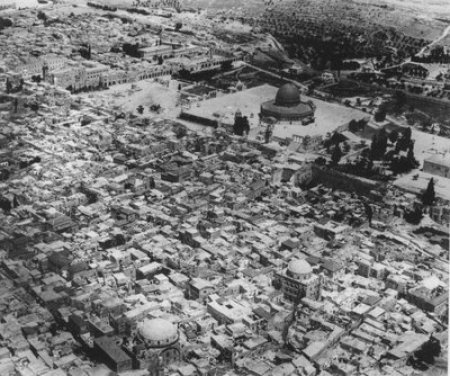
Within the Old City, the Jewish Quarter is by far the most modern -- almost fully rebuilt after 1967 when it was retaken in the Six-day War. It is bounded by the Armenian Quarter (west), Old City walls (south), Temple Mount (south & east) and Muslim Quarter (north). Over 2,000 live there now.



********************************


*************************************
The Hurva Synagogue. This was another domed (& doomed) synagogue. Hurva means ruin. In the 2nd century CE and each of the last four centuries, Jewish buildings were built & destroyed here -- most recently in 1948. In 1721 it was destroyed by Arab creditors and left in ruins for 143 years after Jews failed to pay big debts. In 1864, with help from the UK with their ally Turkey after their Crimean War against Russia (1850s), it was rebuilt as a magnificent Ashkenazi center. For 84 years, it stood almost as tall (130') as the Tifereth (bottom left).


Beneath the dome balcony is the worship facility. The 10 Commandments are under an elegant window behind our loquacious Chicago tour guide.


 We were not admitted to the ground level but walked around the entire inside dome. The huge white dome was ringed with many ornamented stained-glass windows.


***************************************


.jpg)


A friendly student explained that both Sephardic & Ashkenazi Jews (like him) studied & worshipped there. He asked for money & we gave him 50 NIS or $15. But we never learned what was behind that red curtain.




*****************************************
The Cardo. Next, ironically, we saw within the Jewish Quarter remnants of the Roman Cardo Maximus.


This is ironic, because Emperor Hadrian had all Jews banned from entering his Aelia Capitolina -- an entire city rebuilt for Romans only after the 2nd Jewish Revolt in 130 AD. (Hadrian's own family name was Aelius.) Now, its best ruins are seen there.


On 4/29/11 we returned with Melissa & Dan.


 Excavations here began after the Six Day War. Over the ruins was built a large commercial arcade that included some old vaults, covered by an arched roof with small apertures for natural lighting.




Mostly, people owned only what "was necessary" -- what "was needed" -- what "they had." They "made do" with the absolute minimum to stay alive.


Photo Gallery. Inside were displayed photos of death & destruction within the Jewish Quarter during the 1948 Israeli-Arab War of Independence.
In May 1948, all Jews were killed or expelled by Jordanian forces. Most Jewish structures were destroyed, including major synagogues like the Tifereth Yisrael, the Hurva and Porat Yosef (below).
The Tifereth Yisrael ("Splendor of Israel") Synagogue. It was built in 1872 -- 30 yrs. after Jews acquired a site that Russia had sought. Austrian Franz Josef I helped obtain permits from Turkey and paid for its dome (said to be "his hat"). It became a Hassidic center for 75 yrs. In the 1948 war it was bombed as the main Haganah military base and observation point (over 180 ft. high).
On our 8/29/11 visit, only its western wall was standing -- still in ruins.


The Hurva Synagogue. This was another domed (& doomed) synagogue. Hurva means ruin. In the 2nd century CE and each of the last four centuries, Jewish buildings were built & destroyed here -- most recently in 1948. In 1721 it was destroyed by Arab creditors and left in ruins for 143 years after Jews failed to pay big debts. In 1864, with help from the UK with their ally Turkey after their Crimean War against Russia (1850s), it was rebuilt as a magnificent Ashkenazi center. For 84 years, it stood almost as tall (130') as the Tifereth (bottom left).
After retaking the Old City in 1967, Jewish groups disputed whether to rebuild it in a modern style or replicate its prior form. Meanwhile, Israel rebuilt one of the 4 arches that supported the huge dome, as a symbol of Jewish life & hope there.
Finally, with support from Mayor Teddy Kollek & the city, it was rebuilt in its 19th century style. Despite some fears that it may threaten the holiness of Islamic bldgs. on the Temple Mt., it was re-dedicated on 3/15/10. Technically, it is named for the rabbi who started the bldg. that was destroyed in 1721 AD.


On 12/28/10 with the Ohmans (and with Melissa & Dan on 4/27/11), we first went underground to see excavated pagan Roman ruins (rt.) next to an ancient mikva or Jewish ritual bath (left). 


Beneath the dome balcony is the worship facility. The 10 Commandments are under an elegant window behind our loquacious Chicago tour guide.


 We were not admitted to the ground level but walked around the entire inside dome. The huge white dome was ringed with many ornamented stained-glass windows.

These beautiful corner wall paintings depicted tombs of ancient patriarchs & ancesters (here, Abraham on the left, Rachel on rt.)


This synagogue may have regained its former magnificence -- inside & out.


Next, we climbed an outside iron stairway, to circle the outside dome.


Here, vistas were unsurpassed -- including a clear view of our JC.


We descended these stairs and finished our tour with diet cokes and Magnum bars, enjoyed near the small adjacent Sidna Omar Mosque.


At night, from the JC, the lighted Hurva (top rt.) looks like a flying saucer. The photo (left) is how it looks in the daytime -- both taken from our patio.


The Four Sephardic Synagogues. Near the Hurva, these 4 bldgs. were built below ground level at different times after Sephardi Jews came following Spanish inquisitions in 1492 AD. They became interconnected as their congregations grew, each performing different rites.
Yochanan ben Zakai Synagogue. This is the largest, most impressive & oldest of the four. It was named for a rabbi said to have escaped Jerusalem in a coffin during 2nd Temple's destruction in 70 AD. On the rear wall are a shofar & cruse of oil -- said to be used by Elijah to announce Messiah's coming and annoint him.

Middle Synagogue. With more growth in the 1700s, a central courtyard was roofed & turned into this Kahal Tzion or Ha-Emtsai Synagogue. It was renovated after the 1967 war.

Istanbul Synagogue. This was the last one built in 1764, done in the Ottoman style for Kurdish, African & other Jews.

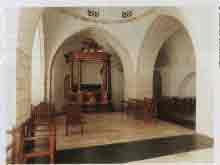
An old engraving shows how it looked when new. Its gilded wooden Torah ark (or "Aron Kodesh") was hand-crafted in Ancona, Italy in the 1600s.

Elijah the Prophet (Eliyahu Ha-Navi) Synagogue. In legend, on one Yom Kippur eve, a 10th man required to make up the prayer quorum appeared, dressed in white. But then he mysteriously vanished. Congregants, convinced that he was Elijah the Prophet, named it after him and moved his chair into a special room.
This synagogue has an impressive Torah ark (or "Aron Kodesh"), from a Livorno, Italy synagogue that was destroyed in WW II.


This view is from the front towards the rear. We saw no separate balcony for the women, who apparently sat opposite men on the same level.


******************************
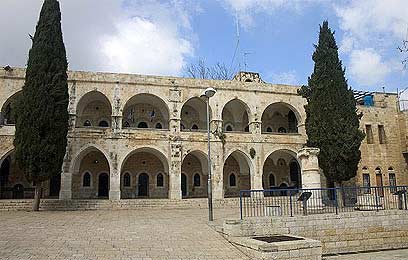
The Rothschild House. Next to the Batei Machase Square is this family House of Arches, built in 1981. It is now a Talmudic school.
From there, we descended one of the oldest passages in the Jewish Quarter.

The Cardo. Next, ironically, we saw within the Jewish Quarter remnants of the Roman Cardo Maximus.


This is ironic, because Emperor Hadrian had all Jews banned from entering his Aelia Capitolina -- an entire city rebuilt for Romans only after the 2nd Jewish Revolt in 130 AD. (Hadrian's own family name was Aelius.) Now, its best ruins are seen there.


During Roman times, after 2nd Temple Period, these were two long north - south avenues -- each, a Cardo (or axis). Our JC bronze model shows them crossing the entire Old City. Cardo Secundarius adjoined the Temple Mount.


These "cardines" converged at the Damascus Gate (also, "Nablus" or "Shechem" Gate). It was then the main entry to Jerusalem and the most heavily fortified. Rebuilt many times, the latest gate was built in 1542 AD by Suleyman the Magnificant and is still the Old City's main north-facing gate.
Most distinctive were the long colonades of 15-ft. tall columns, 20 feet apart. They supported wide porticos that sheltered pedestrian walkways. Beyond were shops, stalls and stores. These were early shopping malls!


Each Cardo was over 70 feet wide. The paved roads themselves were over 40 feet wide -- enough for a 4-lane highway. Two or more chariots could pass side-by-side. These were also early freeways!


We also saw columns still standing as remnants from the Cardo Secondarius -- closer to the Temple Mount.


 Excavations here began after the Six Day War. Over the ruins was built a large commercial arcade that included some old vaults, covered by an arched roof with small apertures for natural lighting.
Some of these excavations are 30 feet deep.


Modern shops are elegant & fascinating. This one had great stone art.


On 2/6/12 we returned to buy a favorite scene of the Temple Mount (center left below), as painted by one Rozen brother onto a chipped-stone base prepared by his brother.


We also liked these pieces before deciding on the one above.


Rome, Greece & others tried to stamp out Judaism forever. But today, modern synagogues & other bldgs. abound in the Jewish Quarter -- while nothing remains here from the Romans & Greeks but a few Corinthian columns!
*****************************************
The Broad Wall. Nearby is this astounding find. When Assyria invaded the Northern Kingdom in 1st Temple Period, refugees flooded Jerusalem. To protect them, King Hezekiah built these massive 24-ft. thick perimeter walls with stones taken from demolished houses (Isaiah 22:10). This proved that the city had become far larger than the City of David.


From the other side, we saw on 2//12 the white lines marking their original height. Also, they were nearly twice as wide as now.


***********************************
The Kotel (Western Temple "Wall"). The Jewish Quarter wraps around the SW corner of the huge (almost 40-acre) Temple Mount. Massive retaining walls still shore up the Mt. -- over 60 ft. above ground on the west side. About half the wall (incl. 17 of 42 courses still below street level) dates back to the grand 2nd Temple of Herod the Great, built before the time of Christ. 
For millenia, the Kotel (Western Wall) has been the Jews' most sacred site. But they have only accessed it since the 1967 war. After the war, a slum was bulldozed to create a huge 5-acre plaza that can hold 400,000 people!


The exposed Jewish part (187' of 1,600') is only 12% of the entire western wall. The rest is in the Muslim Quarter, accessed only by a recently excavated tunnel. (See Nov. '10 and May '11 posts).
Lower courses of Herodian stones are finely beveled, with 2" to 8" margins. This one was 40' long and weighed 570 tons.


Day and night (especially on Friday evenings), Jews pray at the "wailing wall" and bemoan the loss of their holy temple (Psalms 79).

Even the Pope and heads of state have prayed and left notes here.
The south wall includesd Davidson Archaeological Park, where excavations are still underway (see July '11 post, N.T. Archaeol.)


Jews have revered these portions of the Temple mount & kotel more than any other. But Arabs continue to distrust Jewish ambitions to acquire even more.
***********************************
Yishuv Court Museum This charming museum depicted daily life under the Ottoman Empire and British Mandate (1850 - 1948). It was in a narrow passageway winding between the Jewish & Armenian Quarters.
Poor families shared space in scarce rooms -- sleeping on floor mattresses. A canopy bed could be rented for 40 days if a woman gave birth.

Some nicer furnishings were of Jews migrating from Western Europe.

Some rooms had nice utensils used for early cottage industries.

Children played in a shared courtyard with games like roll-the-rim.


The museum complex shared space with two ancient synagogues.


This display showed early clothing styles -- for Sephardic (western Europe), Ashkenazi (eastern Europe) and Turkish Jews. Some were still in use today.

Marilyn examined early homemade Jewish children's clothing.

Leaving the museum, we encountered these orthodox boys leaving school.


Drums and shofars announced a coming procession for a Jewish bar mitzvah. [See also Dec. '11 post, Melissa for Christmas]

Near the Western Wall, we saw an age 13 bar mitzvah boy with his mother -- but preparing on his own -- for his important ceremony. [See Dec. '11 post, Melissa at Christmas.]


First, he wrapped his left arm 7 times with a long leather strap and attached -- as close to his heart as possible -- a tefillin box with selected scriptures (phylacteries) from Exo. 13:1-16 and Deut. 6:4-9, 11:12-21.


Then he measured his head tefillin (frontlets) to fit exactly between his eyes and wrapped the last one in his hand (Exo. 13:16).


Then, with his phylacteries & tallit (prayer shawl) firmly in place, he was ready for his mother to take his photo alongside his display table.


We also saw many orthodox Jewish men.


There were some begging or peddling Jewish or gypsy women.


And some men too.


En route to the Davidson Archaeol. Park (at the Temple Mt. south wall), we saw Old City stairs & arches used in many classic photos & paintings.


[See July '11 post, N.T. Archaeology]
Davidson Arch. Center [JIB 4808 - 4847, MAB 4672 - 4733]

No comments:
Post a Comment