Jaffa Gate. This is the main entry to the Old City -- the largest and busiest of its 8 gates. All highway distances in Israel are measured from there as the "zero mile." It was built at the most vulnerable northern point of defense and the only one built at rt-angles to the wall, perhaps to slow down invaders. 


Over the years it has served as a Roman barracks, a Christian monastery, the Crusaders HQ, an Islamic stronghold and the main Ottoman garrison.


Outer and inner moats (usually dry) were enhanced by the Crusaders.


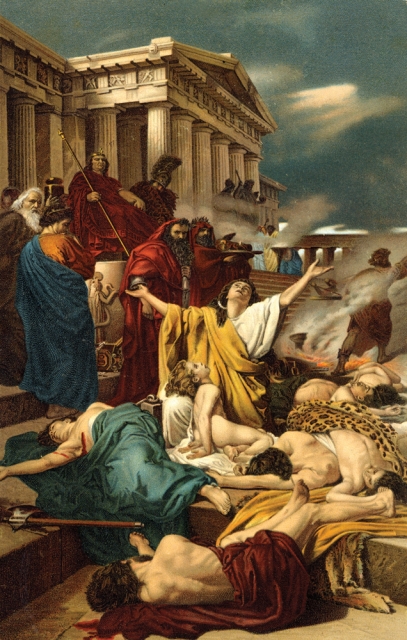


Aelia Capitolina. Reconstructed under Hadrian by 136 AD, it was a city for Romans only -- excluding all Jews.


Roman Christians then built many great churches here -- like the giant Byzantine Nea Church, destroyed by the Persians in 614 AD.


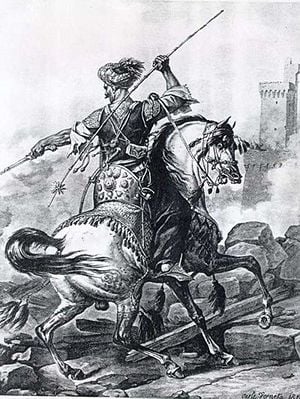


Arabs vs. Jews: Haj Amin al Husseini. [This part was not in the museum.]


We saw this man entering the gate, carrying food in the old manner.

For nearly 3,000 years, Jaffa Gate (bottom left) has been guarded by an important adjoining Citadel.


The Citadel is a medieval fortress with ancient remnants from most periods in the city's long history. It contains archeol. ruins dating back 3000 years. We first came in Dec. '10, but our approach then was pretty random. We returned with Melissa & Dan on 4/21/11 for a more systematic tour.

Over the years it has served as a Roman barracks, a Christian monastery, the Crusaders HQ, an Islamic stronghold and the main Ottoman garrison.


After 1000 BC, King David fortified the Citadel. To honor these origins, the Ottomans built this dominant minaret in 1540 AD and named it the Tower of David. For the past 400 years, it has been a symbol of Jerusalem.

Herod the Great built 3 massive towers in 34 BCE to guard his own adjoining palace nearby. Only the tallest one (with flags) still stands.


It is 145' tall and commands a 360-degree panorama of many familiar sights.
[See May '10 post, Jerusalem with Melissa.]
[See May '10 post, Jerusalem with Melissa.]


The Tower of David Museum: This opened here in 1989 after the Jews retook Jerusalem in 1967. A series of interior exhibit rooms depict the city over the past 4,000 years -- from its beginnings as a Canaanite city to modern times. First was a model of the Citadel as it exists today. Herod's tall tower is bottom right; the sole entry (bottom center) was protected by two ancient moats.

Outer and inner moats (usually dry) were enhanced by the Crusaders.


Using maps, videos, displays, drawings & models, many exhibit rooms tell Jerusalem's long history under its various rulers. Included are the 4 bronze models we use for JC tours, along with these historical descriptions:
Canaanite Jerusalem

1st Temple Jerusalem. Around 1000 BC, David captured a Jebusite (Canaanite) fortress on this site. Below it, next to the main water source at the Gihon Spring, he built the City of David as the HQ of his united kingdom.

Jerusalem withstood assaults from hostile neighbors for over 400 years -- including Assyria's 8th century BC destruction of the rest of Israel.


2nd Temple Period. Greeks under Alexander the Great came before 175 BC.
Oppressive Greek rule led to the Hasmonean revolt:
This painting depicted the Jews' renovation, purification and rededication of the temple under the Hasmoneans in 164 BC.

Roman rule brought to Jerusalem both its greatest glory and its total destruction.
These paintings showed the Temple's western wall during Christ's time, incl. the monumental SW stairway at Robinson's Arch. Note: Herod's palace and 3 great guarding towers (foreground, bottom left).


All were destroyed, along with the entire city, by Romans in 70 AD.


Here with Hadrian, I am smiling more than the Jews did.


Arab Jerusalem. Omar the Great was the first Arab ruler to control Jerusalem.

Crusader Jerusalem. Destruction of the Church of the Holy Sepulcher & other Christian churches, by the Fatimids of Egypt, really ignited the Crusades.


Arab/Islamic Rule. Various Islamic groups ranging from Egypt to Turkey ruled Jerusalem until the fall of the Ottoman Empire in the 20th century.

Mamluk Jerusalem. For 250 years, these Muslim military slaves or mercenaries (mainly from Egyptian) took over much of the Near East.

Ottomans & Suleiman. In the 1500s the Ottoman Empire captured Jerusalem. Turkish Sultan Suleiman the Magnificent improved the city and Temple Mount. He also had today's city walls, gates & the Tower of David built.
He was tolerant of other faiths, but not of the two city architects -- executed for leaving Mt. Zion outside the walls. They are interred just inside Jaffa Gate.

Except for the Crusader periods, Jews & Christians co-existed with Arabs quite peacefully from 638 AD until the 20th century. During the British Mandate, after the Turks were expelled in WW I, the Grand Mufti of Jerusalem & ally of Hitler incited much unrest between Arabs & Jews that continues today.

On our tour of 4/21/11 with Melissa, we inspected the ruins, including part of the "1st Wall" built by the Hasmoneans (after 200 BCE). [See May '11 post, "Jerusalem with Melissa."]

This may be the best place to relive the long & storied history of Jerusalem.

No comments:
Post a Comment