Beyond historic churches we saw on the "Last Days of Jesus tour" [see that Dec. 2010 post], we visited more between Chrismas & New Year's, 2010. We returned with the new group of students in Jan. '11 to see the first one again.
Augusta Victoria Complex (Lutheran).
This is very close to us, incl. Church of the Ascension & the only West Bank specialized-care hospital, all managed by Lutheran World Federation. It was the Turkish HQ in WW I, where they surrendered to Gen. Allenby. It was also a Jordanian HQ & was bombed in the Six Day War (1967).


The church has a high bell tower rising almost 200 ft. above a very high point on the Mt. of Olives -- from where Jesus may have ascended to heaven.


Built under Kaiser Wilhelm II of Germany, and named for his wife, the neo-Byzantine church was dedicated in 1910 and was extensively renovated in the 1990's. It recently celebrated its 100th anniversary.


Directly overhead are mosiacs depicting the Crusaders (Christians) taking the Holy City, and the virgin with Jesus, the four evangelists & 12 apostles.


Among the impressive art work (also restored) are these wall mosaics of the birth & ascension of Jesus--the beginning and ending of his life & ministry.


In the apse behind the main altar is a mosaic with a lamb -- the only one worthy to open the book with seven seals (Rev. 5). On the balcony is a superb painting of the Lord's triumphal entry to Jerusalem on Palm Sunday.


The balcony is supported by a Byzantine colonade. There is also a small altar beneath Moses with the 10 Commandments.


We also came for Mike Ohman to help fix a mechanical problem with their organ. It has a fine sound, magnified by the chapel's excellent acoustics.


Mike diagnosed the organ's problem & worked with another expert to correct its after-run sound. Both Revs. Michael & Ulrike Wohlrab were grateful. The inner bellows were originally operated with these foot pedals. Later, a unique tubular pneumatic system was installed -- but it needs regular maintenance.


Meanwhile, some of their music comes from this small upright piano in the apse.

A climb up 225 steps to the bell tower rewarded us with some sweeping views of our neighborhood--incl. Hebrew University and our own rooftop!


We saw four huge bells, transported from Germany at great expense. Nearby is the Russian Church of the Ascension--an even taller landmark.


In the same complex is this 16-room guest lodging, where JC visitors often stay. Rooms are small but clean, each with a private bathroom.


There is a lovely and tasteful cafe nearby.


Also, a common breakfast area and convenience grocery store are onsite.


Daily breakfast fare includes eggs, breads, spreads & veggies -- but no fruits.

We enter and leave by the same stone entryway -- less than 10 min. from the JC.

Russian Ascension Tower, Convent & Chapels. This stately tower is highly visible, over 200 ft. tall. It pierces the horizon from the east side of our JC.


Nearby are the monastery and a lovely hexagonal convent chapel--
filled with exquisitely painted ceilings and walls.


This elaborate gilded woodwork requires constant maintenance.


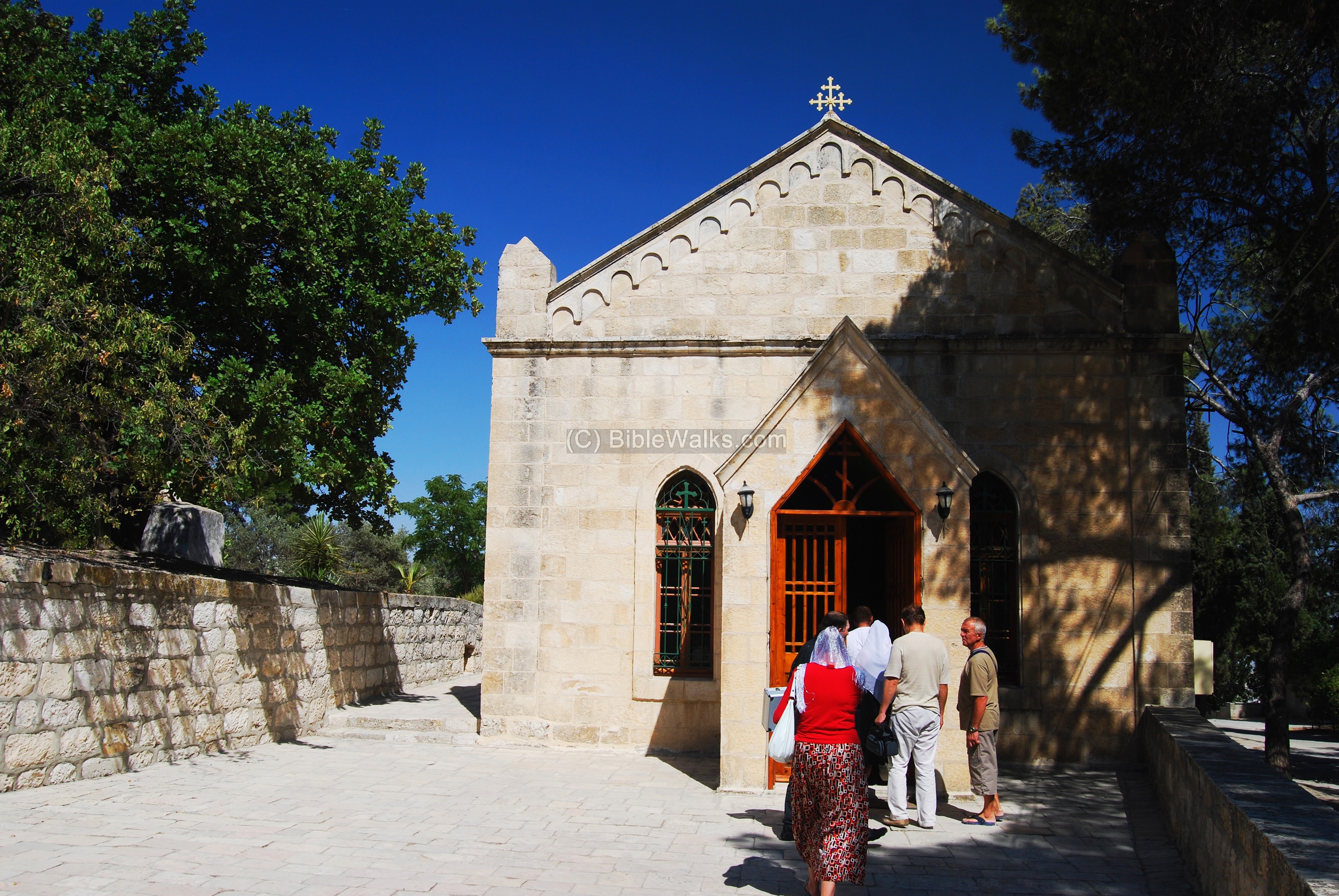
Of even greater historic interest is a separate, smaller chapel built on remains of a 6th century Armenian church. The head nun (Sis. Kristina) let us inside.


She pointed to the spot where by tradition, John the Baptist's head was buried by his followers after Herod Antipas decapitated him in the 1st century. In the 5th century, it was found in a jar inside this floor cavity.


She also uncovered part of a fabled 6th century Byzantine floor mosaic, mottled with colored light streaming through stained-glass windows.


This site overlooks Bethany below. It includes park-like vegetation and a well-tended grove of olive trees.


This unique Russian complex is seldom open to the public -- only for two hours, 10 am to noon, Tues. & Thurs.
Crusader Chapel of the Ascension & Islamic Mosque.
Also atop the Mount of Olives, near the Russian church in A-Tur, is a renovated 8-sided chapel built by the Crusaders to honor Christ's ascension into heaven. It is on the site of a 392 AD church complex destroyed by the Persians in 614 AD. Saladin took it over from the Crusaders in 1198 AD.


Giving respect to this Christian heritage, Saladin had his own minaret (above) and mosque built for Muslim worship (below) next door to the chapel.

Beneath the Crusader dome is a badly damaged stone supposedly bearing the footprint of Christ as he made his miraculous ascent to heaven.

Melissa & Dan really wanted to come here on 4/21/11. We're glad we did.
Lutheran Church of the Redeemer. This Old City landmark is in the Christian Quarter, close to Church of the Holy Sepulcre. Although not a true ascension church, it was also built in the late 1890s by Kaiser Wilhelm II for his wife Augusta Victoria -- like the Lutheran Evangelical Church of the Ascension. (See that Mt. Scopus tower on the horizon, with our JC in between the two towers.)


The Ottoman Empire had granted its ally Kaiser Wilhelm II part of the Muristan (Persian for "hospital") in order to give German Lutherans a presence in the Old City. It now serves a congregation of about 400. This bell tower is the tallest structure in the Old City.


Surrounding an inside courtyard are Crusader-era hallways and a chapel.


There is also a more modern chapel. Kerry & Julianne Muhlstein enjoyed this visit with the students and us on 3/30/11. 


Although the Christian presence has diminished in Jerusalem, landmarks like these will help to keep that legacy alive. [See April '11 post, Christian Churches Jerusalem.]

What wonderful history you share with us through this blog. We love it! Have a happy new year, and we will accompany you through word and picture on your journey. Love, Ron and Joyce
ReplyDelete