Akko (also "Acre," 4/27/11). This ancient port is on the far northern edge of Haifa Bay, near the Syrian border. It has a long & storied history. Like Old City Jerusalem, Old City Akko is a UNESCO World Heritage site.
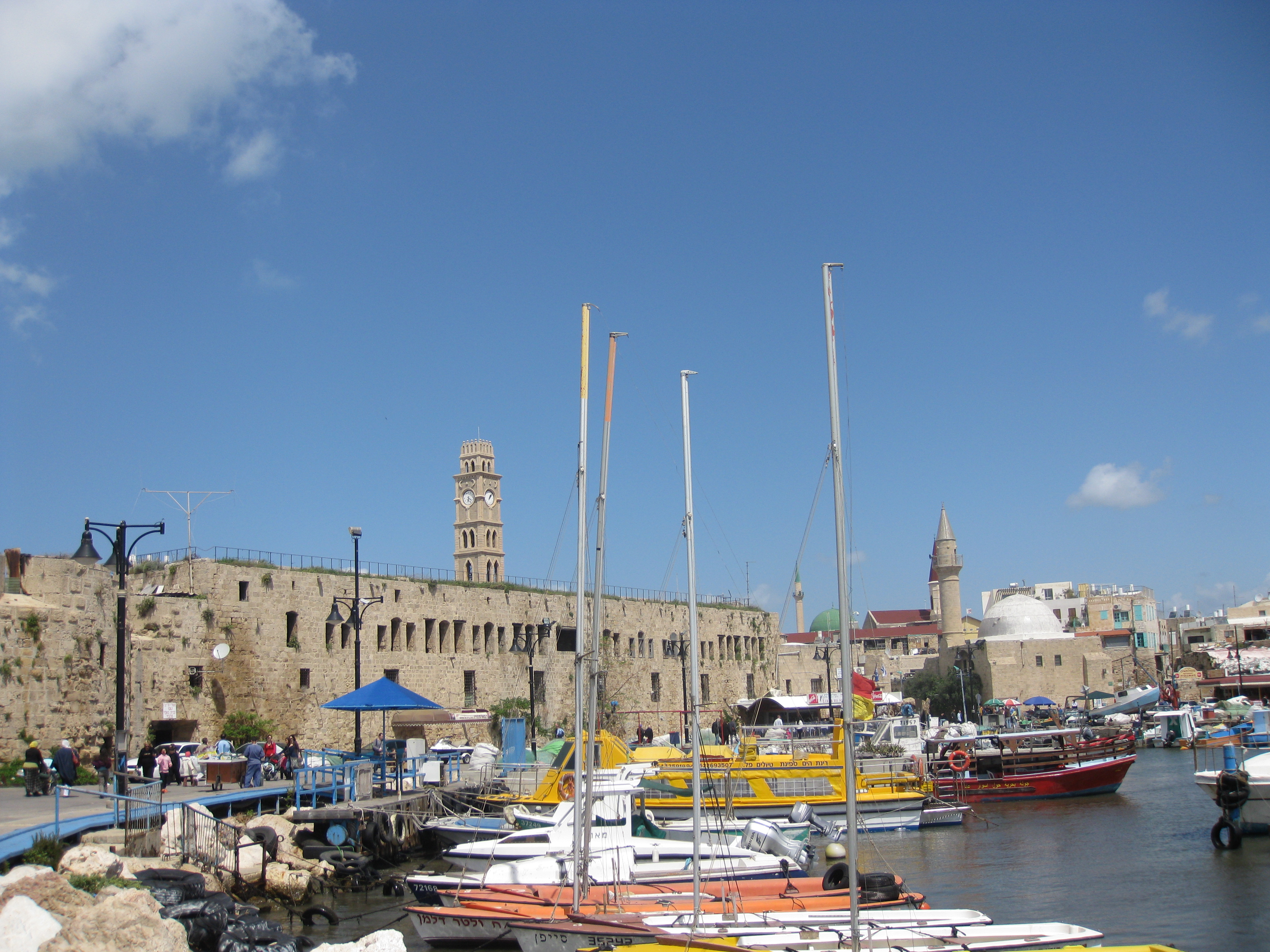

In 1191 AD, Richard I retook it after Saladin had conquered the rest of Israel in 1187. For 100 years it was the Crusaders' last stronghold in the Holy Land. It was also tops on Melissa and Dan's list of "must visit" places.


We started our explorations at these old sea walls and coastal ruins. These helped the Ottoman Turks withstand Napoleon's seige after 1800.


Walking through the Old City, we saw many interesting street scenes.


This is a famous "caravanserei" (Khan al-Omadan or "Inn of Columns") -- the largest of several Ottoman caravan inns still standing in Acre.

The Old City today is 95% Arab, but greater Akko is 30% Arab and 70% Jewish.


Our main destination was Crusader ruins beneath a large Ottoman citadel, used until 1947 as the largest prison in Palestine under the British Mandate. A famous Israeli prison break was dramatized in the movie Exodus. The Crusaders' citadel was used for jousting, lodging, protection and a very early "hospital."


This huge complex included at least six halls -- hospital and lodging rooms, a dungeon, a refectory (dining hall), a Gothic church and Knight's Hall.
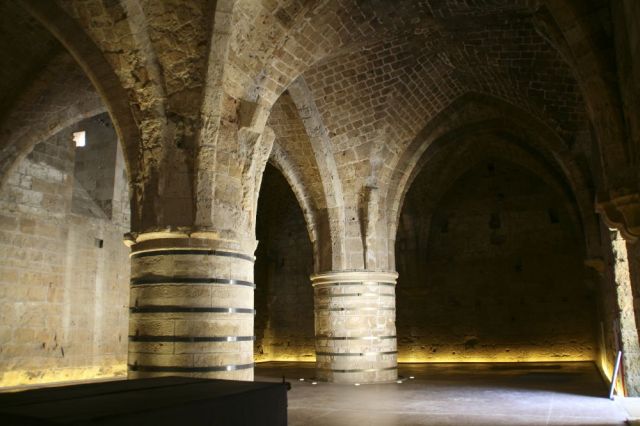

It also contained some interesting privies and wall graphics.

This was the Crusaders' escape tunnel to the port in case the city was overtaken.

Melissa seemed pleased -- and excited -- to come here.


We were too, but somehow we contained our enthusiasm.

Yemin Orde. Our next stop was this boarding school for orphans in the Carmel mtns. near Haifa. During the historic Dec. 2010 fires, 40% of its bldgs. were damaged. Adjoining forests still showed signs of that disaster.


We met Susan Weijel and her assistant Balik, who showed us around.

Most bldgs. had been fully restored in just 4 months -- a remarkable recovery.


In 2011, LDS Charities provided funds to refurbish furniture in six rooms for 24 girls (all age 14). Our money was apparently well spent!


Caeseria-on-the-Sea ("Maritima"). This ancient archaeological gem of the Mediterranean is almost halfway between Haifa and Tel Aviv.

In 25-13 BCE, Herod the Great built it on an ocean promontory and named it for Caesar. It was a Roman capital until the 8th century. Josephus said its harbor was as large as ones at Athens & Alexandria. Herod's monopoly here yielded all the revenue needed to build his mighty works without undue taxation.


We left Melissa and Dan here to swim, then drove down the coast past nature's beauty to see the main excavations (done in the 1950's and 1960's).


We 1st visited the Tiberium, a large amphitheatre built away from the sea.

It seated over 5,000 persons and is still used for productions today.


On tour here in 1999, we met Lamar Berrett's group. He showed us the "Pontius Pilate stone" in about this spot. (Original is in the Israel Museum.)


Closer to the sea and built around the massive harbor was a great complex -- including a Roman temple, Herod's palace and later Crusader fortifications.


This was the impressive entrance to Herod's palace.

All were completely destroyed -- although many are now uncovered, down to the mosaic floors and ancient Roman columns.


Also nearby was this giant hippodrome for chariot races & gladiator games.


This was the largest artificial harbor in the world. Herod built it between two giant breakwaters of concrete. Over time, his underwater building materials failed to withstand nature's earthquakes and ocean waves.


Netanya / Orson Hyde Square. Last stop before Tel Aviv was Netanya Academic College. It was quite distant from Hwy. 4, but worth the effort. We found a unique & beautiful LDS feature created within the main parking lot.


Together, we explored a well-kept garden with lawns, trees and flower beds.

Down the right side, overgrown with vines, were Lucite markers for 7 apostles who dedicated the Holy Land for the gathering of Israel -- Elders O. Hyde (1841), George A. Smith (1873), Albert Carrington (1875), Francis M. Lyman (1902), James E. Talmadge (1927) and John A. Widtsoe (1955).

These were basically dusty, neglected and some were nearly illegible.


These were placed within manicured flower gardens.


Especially notable were markers for David O. McKay (1873-1970) -- who re-dedicated the Holy Land in 1921 -- and Howard W. Hunter (1907-1994), who was so very instrumental in establishing our JC.


All of this was instigated by Dr. Joseph Ginat, an Israeli-born anthropologist, author, professor and political advisor. He completed his PhD at Univ. of Utah and was close to six LDS prophets & scholars. As Vice President at Netanya Academic College until he died in 2009, he created this garden to honor Mormon leaders who had prayed here for the gathering of Israel. With his demise, who knows how long this remarkable garden will endure?

We departed before sundown, leaving the attendant rather dazed & amazed.

Tel Aviv. After dark, we wandered around the downtown area of Israel's largest city in search of its Mediterranean waterfront.
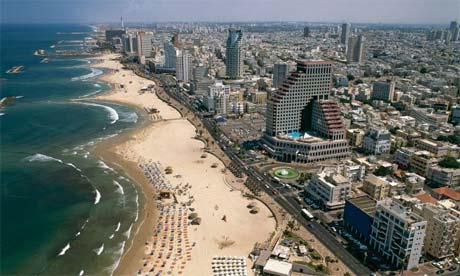

Instead, after countless one-way streets, parked & explored the waterfront on foot, including this lighted fountain outside the landmark Opera Tower.

Also, an Aroma restaurant inside the Opera Tower -- good enough to satisfy our thirst & hunger.

Leaving Tel Aviv at night, we returned to Jerusalem and arrived before midnight.

We had one more day (4/28/11) to spend with Melissa -- in Jerusalem.

I think this mission it way too much fun. We are so jealous. Great pictures. thanks for sharing. MarJane
ReplyDelete