(Thurs, April 21) -- Old City Streets. Leaving the Temple Mount for the crowded streets of Jerusalem, we saw many varied shops & goods in the very cramped, enclosed arcades. [Thanks again to Morris Thurston for many of these superior shots. See www.morristhurston.com/blog.]


Arab Orthodox Society. Our destination was lunch with Nora Kort, after visiting her St. Benedictus Clinic where we had provided some much needed medical equipment. [See Oct. '' post, "Humanitarians - Old City."]

Wujoud Museum. Nora is an amazing woman who supports many worthy charitable causes. Her home base is this new museum on David Street, near Jaffa Gate. Wujoud means "experience," in celebration of the Arab culture.


Directly behind her museum is the now-neglected site previously thought to be "Hezekiah's Pool." (More on that later in this post.)

We enjoyed a sumptuous hot lunch served by some clinic personnel.

Afterwards, as we approached Jaffa Gate, the Greek Orthodox Patriarch and his entourage were in procession to the Church of Holy Sepulcher.


We also found four BYU students (Piers Tueller, Megan Brink, Mark Laney & Mady Gordon) on tour after completing their Winter Term 2011 at the JC.

The "Tower of David" Citadel. [See also Dec. post, "Cardo & Citadel"].
This is a medieval fortress with ancient remnants from most periods in the city's long (4,000 year) history. Citadel foundations were first laid by King David after 1000 BC. Ottomans built the minaret in 1540 AD, naming it for David -- as the permanent symbol of Jerusalem.

This courtyard contains archeological ruins dating back 3000 years. We came in Dec. 2010. But our inspection then was more random than systematic.

Herod built the tallest tower (with flags). It still stands, affording panoramic views of the area -- including many facilities visited with Melissa.

The 7 Arches Hotel overlook of the Old City from the Mount of Olives.

The new Hurva Synagogue (destroyed and rebuilt several times).

Church of the Holy Sepulcher (holiest site to most Christians).

Temple Mount, the Mount of Olives and Church of the Ascension.

Lutheran Church of Our Redeemer (tallest tower in the Old City).

And, of course, our own JC at Mount Scopus - on the horizon.

Tower of David History Museum. This was built after the Jews retook Jerusalem in 1967 and opened in 1989. A series of interior exhibit rooms depict the city over 4,000 years of history -- from its beginnings as a Canaanite city to modern times. All of the large bronze models we use for JC tours are seen there. But first came a model of the Citadel as it exists today. Herod's tall tower is bottom right; the sole entry (bottom center) was protected by two ancient moats.

Using maps, videos, displays, drawings & models, the exhibit rooms told the history of Jerusalem under its various rulers. For example, here with Emperor Hadrian (who rebuilt Jerusalem "for Romans only" after it was destroyed in 70 AD), I am smiling more than the Jews did.

On this tour of 4/21/11, we wandered down among the ruins, including part of the "1st Wall" built by the Hasmoneans (200 BCE).


Also, this Roman-Byzantine cistern (500 AD). It was a memorable visit.


Night Spectacular. That night, we returned to the Citadel for its sound & light show. Jerusalem's many periods of history are depicted by images projected on the walls surrounding our seating area. It was very colorful and impressive.


However, we left before it was over, blown away on a cold & rainy night.
The Ramparts Walk. [See also Nov. 10 post, "Ramparts & Kotel Tunnel"]
This was high on their "to do" list. Starting at the main Jaffa Gate, we summited these ancient city walls (nearly 500 years old). In Nov. 2010 we walked toward the Temple Mount, exiting at Dung Gate. This time we walked toward Damascus Gate, with the Citadel looming prominently behind us.

Built of Jerusalem limestone under Turkish Sultan Suleyman the Magnificent, these walls encircle the Old City for 2-1/2 miles -- largely following the footprint of former Crusader walls. More than half of them were recently turned into a rough but walkable path. First built for military protection (see quote below from an early sentinel there), the walls are now only a scenic landmark and viewpoint.

The King David Hotel & YMCA tower are on the western horizon, with the new upscale Mamila mall and hotel in the foreground.

The newly installed light-rail system has undergone testing for about a year. It will run to Govt. Center & is supposed to help relieve street congestion. (Note the knot of cars clustered beside it.) But it is still "running on empty."

Also outside the walls is the Notre Dame Center with hotel, offices & convention hall, across the street from "New Gate" (recently built in 1887).

Also interesting were views of sights inside the walls. Remarkable Terra Sancta convent & chapel, with its slender steeple, adjoins New Gate.


We saw both backyard gardens and rooftop electronic paraphernalia.


After descending at Damascus Gate, we saw many distinctive faces.


These perpetual backgammoners enticed Melissa & me to have a memorable game on our last night -- not won by either of us until the very last roll.

Today they arose late due to jet lag. After some morning duties & lunch came an afternoon tour of the BYU Center. [See Sept. post, "Hosting at the JC."]

The JC flower gardens were in full springtime bloom.


The Great Synagogue. Attending Mincha/Kabalat services here was a unique experience, starting at Fri. 4/21/11 sundown on the Jewish Sabbath. This Orthodox synagogue in West Jerusalem was built in 1982, replacing one from 1958. It was dedicated to holocaust victims and fallen Israeli soldiers.


As the name suggests, it seats 1,400 persons (550 in the balcony, 850 below). Cameras were deposited at the front desk, so these photos were online.
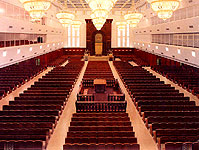
There are some large, elaborate chandeliers in the entry and the main hall.

Most notable to us was the choir and cantor. Such music is also unique for Jewish services. This was a great way to honor Jewish Passover and start our own Sabbath at the JC the next day.

(Sat., 4/22) -- Easter Sabbath. [See May post, "Palm Sunday in Israel"]
Today at our Sacrament Service, Melissa sang Our Savior's Love (Marilyn accompanied on the piano). I spoke on Jesus in Gethsemane.

Orson Hyde Memorial Garden. After Church, we enjoyed sack lunches here while overlooking the Temple Mount and Old City. [See Nov. 2010 post, "Olive Processing - Hyde Garden".]


Princess Basma Murals. Then we visited this disabled children's rehab center to inspect the 10 wall murals painted by BYU students starting in 2007. The children weren't there on weekends.


Crusader Chapel of Ascension and Islamic Mosque. Atop the Mount of Olives is a renovated 8-sided chapel built by the Crusaders to honor Christ's ascension into heaven. It is on the site of a 392 AD church complex destroyed by the Persians in 614 AD. Saladin took it over from the Crusaders in 1198 AD.


Respecting this Christian heritage, Saladin had a minaret (above) and mosque built for Muslim worship (below) next door to the chapel.

Beneath the Crusader dome is a badly damaged stone supposedly bearing the footprint of Christ as he made his miraculous ascent to heaven.

Dan and Melissa really wanted to come here -- and we're glad that we did.
The Muristan. Before sundown, they caught the #75 bus from Mt. Scopus back to the Old City. In the heart of Christian Quarters was a complex of streets and shops called the Muristan ("hospital," in Persian). There the first Crusader hospital was founded on a site earlier used for a hospice to care for the sick in Hadrian's Aelia Capitolina (150 AD).

Today, much of this area is used for a souq ("market" or "bazaar"), with shops and cafes built in the late 1800s. In the center is this ornamental fountain. Note the Lutheran Church of the Redeemer (built in 1890s for the Germans there). Inside was preserved some of the early hospital and church.


Holy Fire at Holy Sepulcher Church. [See April post, "Christian Churches"]
Nearby in this sacred bldg., they saw part of a unique Easter spectacle. For 1,000 years on "Light Saturday," the day before Easter, the Greek Patriarch enters what most Christians consider Jesus' tomb. Eventually he emerges from the dark tomb with lighted candles -- like Christ came forth as "Light of the World." That candle then ignites others in the church, the Old City & the world. Melissa & Dan arrived too late to see that. But many candles were still burning.


Today we saw closeup some sites shown on models at our JC and the Citadel. Ruins of the ancient City of David are being excavated just above the Kidron Valley -- opposite the Arab village of Silwan and SE of the Temple Mount (below rt.) Built in the 8th century BC, the famed Hezekiah's tunnel ran full-length beneath these ruins.

Water still runs thru the tunnel. This cartoon board shows the daily water level -- today just below the waist. From the initial descent into the tunnel, this was both rigorous and exciting. [See our Nov. 2010 post, "City of David".]


There are some pretty tight squeezes here.


While these adventurers conquered "Hezzie's Tunnel," we chose the dry tunnel -- built about the same time for people to walk and draw water directly from Gihon Springs. We all came out at about the same place.


Near the exit points is the final destination of the water tunnel -- the Pool of Siloam. It's actual location has just recently been discovered.


Water in this pool was used not just for drinking but also for purifying the 2nd Temple's altar and persons attending the temple or in contact with the dead. It was a community facility, where Jesus healed the man blind since birth.


This Sunday and its surroundings were both beautiful and interesting.

After walking down Ben Yehuda Street in West Jerusalem, we drove one of the JC cars to Tiberias and the Sea of Galilee for our next adventures.


No comments:
Post a Comment