Hebrew University of Jerusalem -- Mt. Scopus.
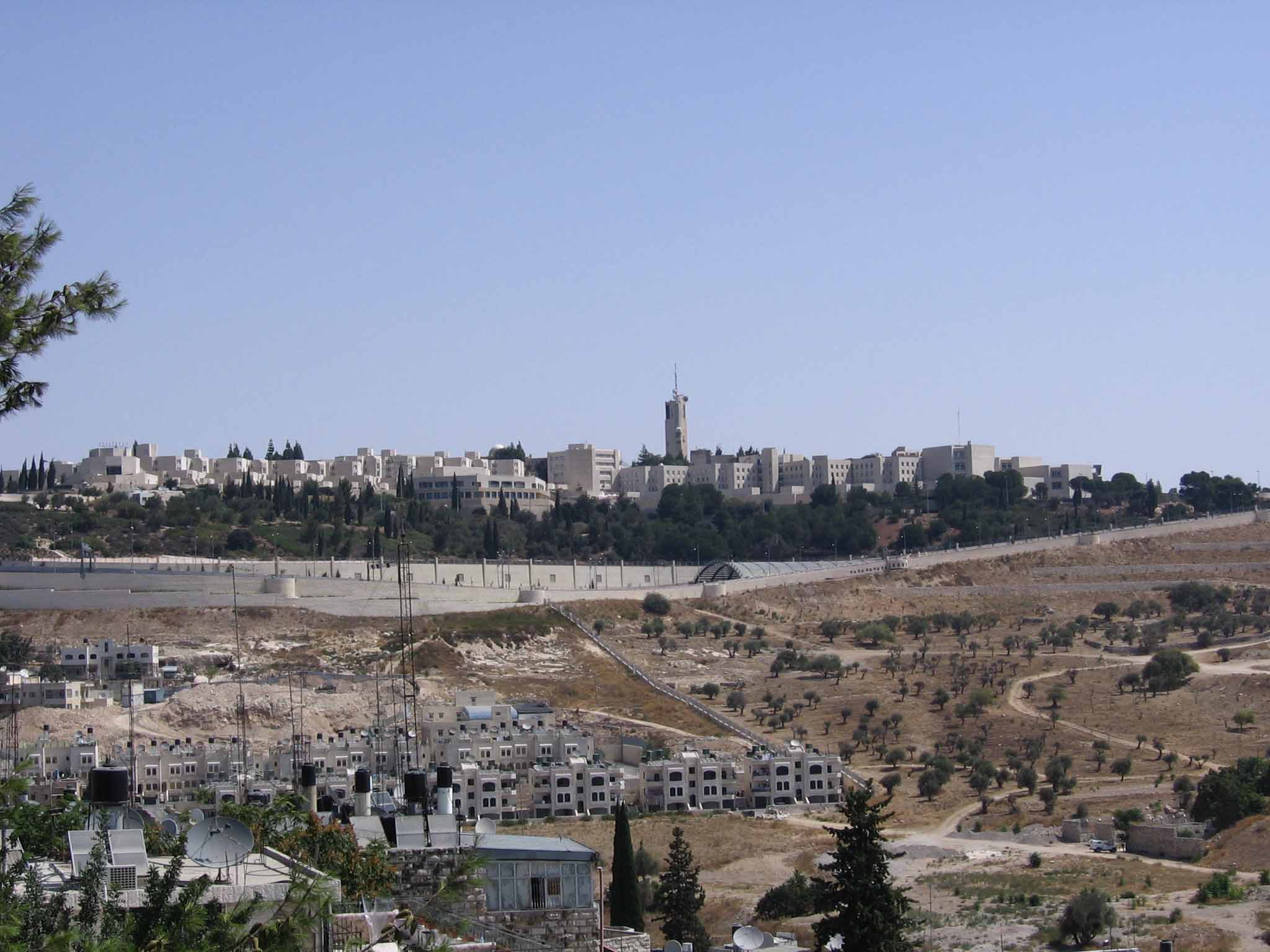
This is Israel's largest and top-ranked university. It has 22,000 students on 4 campuses in or near Jerusalem. Near our JC, the Mt. Scopus campus is the oldest and largest one, opened in 1925. Its military tower is a prominent icon on the skyline.



Faculty of Law.
After the Six-Day War in 1967, Israel retook control over Mt. Scopus. The school there was rebuilt and reopened in 1981 as the main campus. Since then, the law school complex has included the historic domed National Library bldg.


The 4-year school has almost 1,000 undergrads & about 400 grad students, with 40 professors & 100 adjuncts.
On 5/31/11, I toured the complex with Prof. Nathan Oman, visiting for 6 weeks from Wm. & Mary Law School, as arranged by Georgetown Law Center.


The law complex had many nicely landscaped walks & park-like areas.


Honoring Pierre D'Albert. On 12/26/11, we returned with Melissa to honor the husband of Melissa's beloved Harbor Day School teacher, Judy D'Albert. Pierre had arranged a generous bequest to Hebrew U. after his passing on 1/3/10. This earned a prominent plaque on their honorary Founder's Wall.


 Melissa expressed her loving admiration for Pierre & Judy. (Note the art object she will bring to Judy).


 In the Sherman Admin. Bldg. during our 12/26/11 tour, we also saw a photo of "Old Blue Eyes" himself attending its dedication with his wife in the 1990s.
Adjoining it was this heavily-leaning tree that was "shaken but not uprooted" by the incident. Tears of both joy & tragedy have been shed on this campus.


This is Israel's largest and top-ranked university. It has 22,000 students on 4 campuses in or near Jerusalem. Near our JC, the Mt. Scopus campus is the oldest and largest one, opened in 1925. Its military tower is a prominent icon on the skyline.
This is the front entry -- off Hebrew Univ. Blvd. (Hwy #1, past the JC).

This is the rear entry, nearest to parking lots and Aroma Restaurant.

Hadassah Medical Center ("Hadassah" is Hebrew for the biblical "Esther").
Built in the 1930s on the Mt. Scopus campus, it and the university were isolated during the 1948 Arab-Israeli War. It was closed after the 4/13/48 medical convoy massacre of 78 doctors & nurses -- including its director, Dr. Chaim Yassky. Below is a campus memorial to the massacre.After that, Hadassah provided medical services in rented space. In 1962 it opened a new hospital & medical school in picturesque Ein Kerem (near West Jerusalem). In 2011 it had 700 beds and 130 depts. & clinics in 22 bldgs there.
After Israel re-occupied Mt. Scopus in the Six-day War of June 1967, the hospital there was renovated & re-opened in 1975 with 300 beds and 30 depts. & clinics.

Just east is the adjoining Arab neighborhood of Isawiya. [See my May '11 experience after Nakba Day in Sept. '10 post, Political & Civil Events.]


After the Six-Day War in 1967, Israel retook control over Mt. Scopus. The school there was rebuilt and reopened in 1981 as the main campus. Since then, the law school complex has included the historic domed National Library bldg.


The 4-year school has almost 1,000 undergrads & about 400 grad students, with 40 professors & 100 adjuncts.
On 5/31/11, I toured the complex with Prof. Nathan Oman, visiting for 6 weeks from Wm. & Mary Law School, as arranged by Georgetown Law Center.

The Bernard G. Segal Law Library is the largest in Israel, with 300,000 volumes and some unique collections of legal philosophy. This bust is of Maimonides ("Rambam"), an early Jewish legal scholar & advisor to Saladin (after 1187 AD).


In 2011 this was the largest & most prestigious law school in Israel.
 |

The law complex had many nicely landscaped walks & park-like areas.


Flower beds bloomed abundantly in the late springtime.


Honoring Pierre D'Albert. On 12/26/11, we returned with Melissa to honor the husband of Melissa's beloved Harbor Day School teacher, Judy D'Albert. Pierre had arranged a generous bequest to Hebrew U. after his passing on 1/3/10. This earned a prominent plaque on their honorary Founder's Wall.


Melissa recalled that Pierre attended her 2005 high school graduation, despite suffering debilitating injuries in 2001. During his first 84 years, he had been a brilliant creative artist -- including 15 yrs. in the movies.

Earlier on 12/26/11, we had been led into a small auditorium for a brief ceremony conducted by the Division for Development & Public Relations.


Our entire visit was arranged by the delightful Faith Segal ("USA Desk"). She introduced her boss, Joseph Benarroch (Division Director).

He explained in detail Hebrew U's 86-yr. history, noting that Pierre had shared Einstein's vision for higher education as the top priority for the new state of Israel. (While residing in Egypt, Pierre had helped to defend his cousin Michael Cohen's kibbutz during the 1948 War for Independence.)
Melissa expressed her loving admiration for Pierre & Judy. (Note the art object she will bring to Judy). Then Marilyn & I added some insights about their warm & unique 40-year companionship.
We exchanged many warm sentiments about the D'Alberts & Hebrew U.
After a sumptuous afternoon repast (eagerly devoured) in the Sherman Admin. Bldg., we saw their 9 Nobel winners -- including Albert Einstein!


Joseph & Faith also provided Melissa with an Israeli hamsa to give Judy. Created by David Gerstein, it was a good luck charm (the "Hand of God") designed to ward off evil. The dove and olive branch symbolize hope and peace for Israel. On 4/4/12 Melissa presented it to Judy at our home.


At Hebrew U, we saw another large metal "hamsa" sculpture done by the same artist -- against a backdrop of domed campus bldgs.

Tour of Hebrew U. Campus. Faith and Nava (a Hebrew student) next led us on an extensive campus tour -- starting with some lovely botanical gardens.


Even in wintertime, the pools & streams fed some gorgeous vegetation.


These gardens provided a serene, pastoral setting for this urban campus.


Inside a hewn rectangular courtyard was the famous Nicanor burial cave -- used between the 1st & 4th centuries C.E.

We entered a large burial hall with numerous niches inside.

Faith explained that early zionists had envisioned this site becoming Israel's national pantheon cemetery -- instead of Mt. Herzl -- before Mt. Scopus became Jordanian occupied territory during the 1948 War.

Nearby, fronting the iconic tower, was the new Shappell Jewish Studies Library.


From the Shappell Plaza outside, we had a good look at the tall 1920s military observation tower -- as updated with modern electronic equipment.


Next was the historic Rothberg Amphitheatre. In June 1967, after the Six-Day War, the campus reopening ceremony was held there.


On that same occasion, IDF Chief of Staff Yitzak Rabin received his honorary doctorate & delivered a famous speech there. Under his command, Israel had achieved total victory and recaptured Mt. Scopus in 1967. (In 1995, after signing the Oslo Accord with Yassir Arafat, he was the only P.M. to be assassinated.)

The original 1925 campus opening & dedication ceremony had also been held on that same site.

Overlooking it, we had an amazingly clear view of Bethany, Ma'ale Adumin, the Judean desert & Jordanian mtns. beyond -- incl. Mt. Nebo!


Nearby, the Truman Research Institute honored the U.S. President who ensured that our country was the 1st to recognize the new nation of Israel.


On an outside patio were more striking views -- of both our own BYU Center and the Old City (to our right).


The Nancy Reagan Plaza promoted a spirit of political bipartisanship.


On 5/31/11 I first saw the Frank Sinatra Inter'l Student Center & Cafeteria.


 In the Sherman Admin. Bldg. during our 12/26/11 tour, we also saw a photo of "Old Blue Eyes" himself attending its dedication with his wife in the 1990s.
Sadly, that was also the site of a terrible suicide bombing in 2002, during the 2nd Intifada. Then, a Hebrew U. employee killed 9 & wounded 70 others during a crowded lunch hour. We saw this memorial to those who died in that disaster.
Adjoining it was this heavily-leaning tree that was "shaken but not uprooted" by the incident. Tears of both joy & tragedy have been shed on this campus.


Next, we climbed some stairs to the Hebrew U. Institute of Archaeology. It housed some of the most impt. archaeological work done anywhere in the world.

In the lobby were some ancient floor mosaics. Also, a huge wall mosaic showing Assyria's conquest of Lachish -- like that in the Israel Museum.


Surprisingly, the door to its main workshop was left ajar. Peeking inside, we saw a student hard at work on some ancient artifacts.


Outside was a bank of hardy, still-blooming geraniums.

This is a large, well-appointed and nicely-landscaped campus.


Inside the Maiersdorf Faculty Club was a bookstore and cafeteria.


Outside were more panoramic views atop a rooftop patio eating area.


This was how our BYU Center is viewed from that rooftop.


We close this campus tour with one last look at Albert Einstein -- seen riding his bike across campus -- with some classic wisdom.


This was a memorable, moving experience for us. We hope this pictorial view of Hebrew U's Mt. Scopus campus is also helpful to Judy D'Albert.

British Military World War I Cemetery.
Northeast of campus is this lovely cemetery. Many soldiers in Gen. Edmund Allenby's Expeditionary Forces that liberated Palestine from the Turks were interred here. The memorial chapel at the end of the cemetery named the troops killed -- but graves were still unknown.

It also included many Australians plus 24 Jews who died in Israel during that conflict.


No comments:
Post a Comment