On 7/25/11 we had our only field trip with the Spring/Summer students -- one we had really wanted to take. It was worth the wait.
Wohl Archaeological Museum. We first saw ruins of 6 mansions (yeshivahs) built in New Testament times for priestly families -- in the elite Upper City. They are now in the Old City's Jewish Quarters.


All of these multi-level buildings were burned by the Romans in 70 AD and later buried. They have only been excavated since 1995. Each mansion had several mikvas used for frequent ritual cleansing baths.


Colorful wall frescoes showed how luxurious these buildings once were.


Some floor mosaics were still quite beautiful.

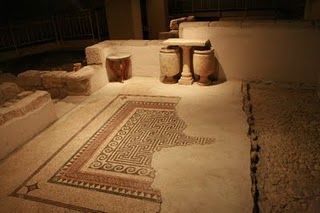
This was the "Chadwick mosaic." (Jeff had it duplicated for his Utah home.)


Many cooking & eating utensils were excavated.


Also, stone jars -- like those filled with water that Jesus changed to wine.


Burnt House. Nearby was an elegant residence excavated 1970, exactly 1900 years after Romans burned it. The Talmud described a wealthy, abusive priest ("Katros") who may have lived here with his family.

Inside were 4 rooms (with kitchen, work shop & mikvah), all 20' below today's street level. Best of all: It was cool on a very hot day (92 F)!

Discovered were more jars, ink wells, coins, lamps, a large metal spear (in the Israel Museum) and human remains (since reburied).


All were layered with ash from the Roman burning. Some hid from the Romans in tunnels (rt.). We saw a 12-min. video dramatizing a priestly family with different poli. opinions, their debate whether to leave town or prepare for the Romans, destruction of the temple, then their home & family. These beveled Herodian stones or "ashlers" were also covered with ash. 

Jerusalem Ophel Archaeological Park / Davidson Centre.
This may be Israel's best antiquities site. It is at the SW corner & the south wall of the Temple Mount where Jesus surely walked. Marilyn came with Melissa on 12/27/11 and we returned on 2/6/12.


Before entering the outdoor park, we visited the Davidson Center -- between Dung Gate and the Western Wall. It had films showing 2,000 years of history, and displays of artefacts found at Herod's great 2nd Temple there.


We saw the earliest document from Jerusalem -- a clay fragment of a letter sent to the 14th BC pharoah by Abdi-Heba, the Egyptian king of Jerusalem.


At the pinnacle was the trumpeter's corner where the start and close of each sabbath was heralded (as demonstrated by Lizzy Tingey on 7/25/11). There, Jesus may have stood when tempted (Matt. 4:5-7).


Crossing the street overhead was a giant ancient staircase supported by Robinson's Arch -- named for its 19th century explorer.

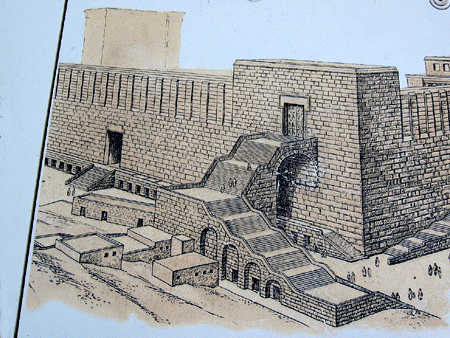
Some stones protruded from the wall at the huge arch's top.


At the arch's base support were 4 large portals that opened to some ancient shops -- that also lined both sides of the busy street.


The road was crushed open when the Romans pushed temple & wall stones onto it. "Not...one stone [was] left upon another that [was] not thrown down" (Matt. 24:2). Beneath it were drainage channels or an even older 1st Temple road -- still being excavated.


A large pile of stones was right where they fell 2,000 years ago.


Some stones still showed their careful Herodian craftsmanship.


That was also seen in the continuation of the Western ("Wailing") Wall.


Opposite the wall were other remains -- many covered with moss.


Some colorful heather was blooming in the winter weather.


Some yellow flowers also brightened the scene.


After ascending those same stairs, we approached the 7th century AD Muslim Umayyad palace site -- as outlined by the rows of cypress trees.

From there, the Caliph had his own private stairs to enter the Temple Mt.
Along the south side were many mikvas (ritual baths) and temple housing ruins. Al Aksa Mosque was above & the Mount of Olives beyond.


This is another artistic depiction of the Huldah Gates. They were likely named for a 1st Temple prophetess who held court there under King Josiah and also may have been entombed there (2 Kings 22:14-20).
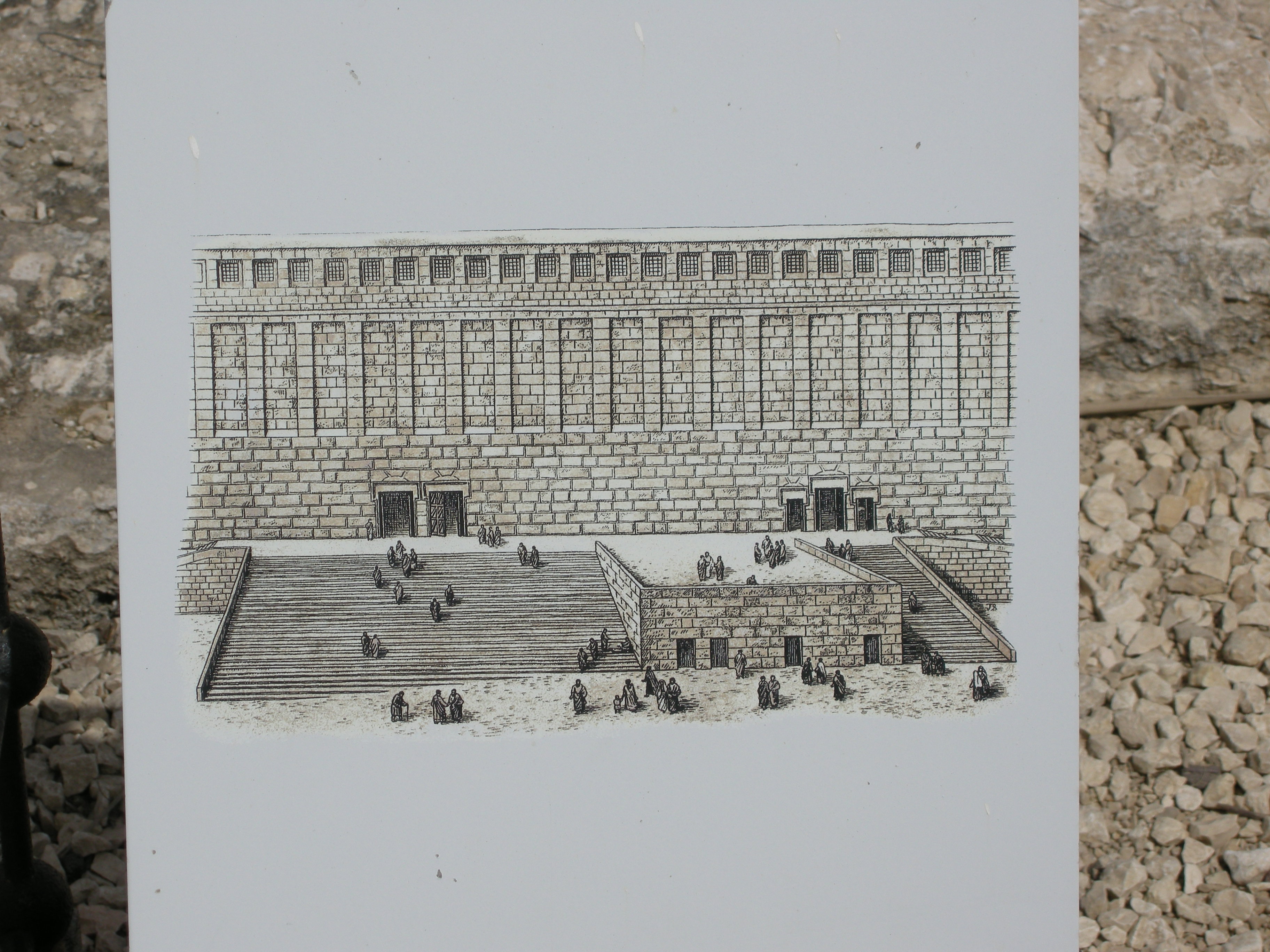
Jesus would have entered thru the triple gates (now blocked, but still visible in the middle of the south wall).


This lowest doorpost stone had a Hebrew inscription -- giving thanks for being healed from an affliction.

Exit was thru the double gate -- now just below Al Aksa Mosque. Only half of one gate is still visible.


When Neil Armstrong toured the Holy Land in 1988, his guide assured him Christ had walked on these upper steps (carved into the bedrock). He said, "Walking here means more to me than walking on the moon!"


Beside the gate's lintel was a stone inscribed in dark Latin letters from Hadrian's time (135 AD) -- but inverted when used by the Umayyids.


Another stone was carved with a nice rosette.

Pigeons made good use of vacant spaces.

Note the interesting scaffold at the far SE end of the south wall. When the wall bulged 20 years ago, neither the Muslims nor Jews took responsibility for the repair -- so they jointly hired a Jordanian firm. But neither side would take responsibility for removing the scaffold. So it still hangs there today!


Finally, we overlooked the recent excavations of ancient mikvahs and adjacent housing ruins -- many of them decked out in winter green.


We were grateful for what we had seen and learned. Marilyn internalized her knowledge while I recorded it in writing on 7/25/11.


Our Muhlestein group had a hot but memorable day.

On 7/25/11, we boarded vans back to the JC for lunch -- and A/C !

On 2/6/12, we retraced our steps along the wall & the Umayyad palace.


This site deserved even more than the 3 visits we made there.


No comments:
Post a Comment