The Israel Museum is the country's largest cultural institution. Founded in 1965 by Mayor Teddy Kollek on 20 acres near the Knesset, it has the most extensive biblical holdings in the world -- nearly 500,000 items. In 2010, a 3-year update was completed with new galleries, entrance facilities and public spaces.


We came on 3/27/11 and again on 8/22/11. Outside we saw the original 4th century A.D. basalt synagogue lintel (with conch shell decor) that we had seen copied at Chorazin on the Galilee just one week before, on 3/17/11.


We also saw another Chorazin lintel from 564 A.D., incl. a carved menorah.


"Greeks, Romans & Jews," Hall 4.
Mosaic and remains at the Herodium, just outside of Bethlehem.


"Muslims and Crusaders," Hall 7. Islamic gateway and dinnerware


Turkish gold filigree


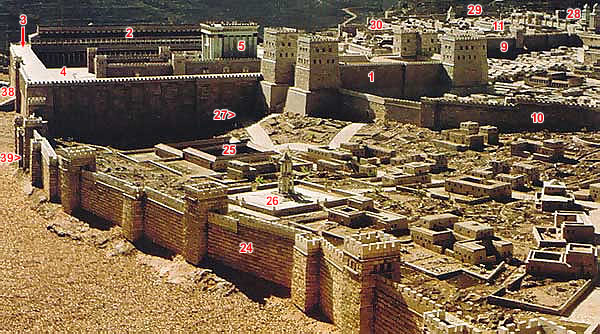
Model of Jerusalem in Jesus' Time
Between the Israel Museum and Shrine of the Rock is a scale reconstruction of Jerusalem as it looked before the Romans destroyed it in 70 AD. It was originally built in 1965 on grounds at the prior Holy Land Hotel when Jews could not visit the Temple Mount. In 2006, some 1,000 pieces were transported on a flat-bed truck to the present site, taking 66 days to move.



We came on 3/27/11 and again on 8/22/11. Outside we saw the original 4th century A.D. basalt synagogue lintel (with conch shell decor) that we had seen copied at Chorazin on the Galilee just one week before, on 3/17/11.


The inside promenade had 3 huge wall mosaics from Leontis' 6th cent. AD Jewish mansion. It depicted Hellenistic scenes of Odysseus.


Canaanite Hall 2. Our main interest in coming was the Bronfman Archaeology Wing. Fronting it were some very distinctive Egyptian coffins.

Canaanite & more recent glass objects were well preserved in tombs.


These were clay ossuaries -- for holding decomposed human remains.


Instruments of war and 14th century dueling stone lions from Beit Shean.


More lions awaited inside one of the 2-chambered gates at Hazor.


"Israel & the Bible," Hall 3. Ivory furniture inlays from King Ahab's fabulous "ivory palace" in Samaria.

Ornate Greek jar and lion-head bowl.


Wall showing the Assyrian destruction of Lachish (8th cent. BCE)


Assyrian silver hoards -- Ekron & Eshtemoa. (Like the hoards Lehi had left in his "land of inheritance," 1 Ne. 3:16, 22.)

Hezekiah's tunnel -- "Siloam inscription" where 2 excavation teams met.
(The original is in a Turkish museum in Istanbul.)

Four-horned altars, Tel Beersheva.


Holy of holies -- Israelite temple at Arad (Hezekiah, 8th cent. BCE)

Edomite pagan ritual objects

Edomite idol and Philistine stands with ceremonial bowls.


Israelite jars and musical instruments.


Burial cave for the slain after 1st Temple destruction, 586 BCE

"Jerusalem cave" in Lehi (So. Israel) inscribed with sailing ships and 1st mention of Jerusalem -- "YHWH is God of the whole earth, the mountains of Judah belonging to Him, to the God of Jerusalem" (after 586 BCE).

An entire room was filled with "early Hebrew writings." Also, a reusable writing tablet (black wax in a wooden frame -- likely the "sticks" of Ezekiel 37.)


Mosaic and remains at the Herodium, just outside of Bethlehem.


Mosaic & well-preserved objects from Herod's tomb at the Herodium.


Another Roman mosaic and elaborate Corinthian column.


Less elaborate Ionic column -- outside the museum.

A badly damaged limestone block with a dedication to Tiberius Augustus of Caesaria's amphitheatre, done by "[Po]ntius Pilatus, [Praef]ectus of Judea." This is the only known archaeol. evidence of Pilate as Roman governor in Israel.

Well-preserved ossuary of Caiaphas -- the high priest who condemned Christ.

More ossuaries of that period (after 2nd Temple destroyed, 70 AD)

Nailed ankle bone of a crucified man (Yehohanon, son of Hagkol).

Alexander the Great (died at age 33) and his father Phillip of Macedonia alongside a Greek goddess.


Roman art, busts and silver objects.


Roman statuary (copies of Greek originals)


Beautifully ornate Qu'ran


This amazing museum deserved another visit ... or many more. [We spent the entire day there with Melissa on Thurs. 12/29/11. ]
Shrine of the Book Museum. Outside the Israel Museum is this remarkable facility.
Built in 1965, a white dome covers a structure placed two-thirds below the ground -- surrounded by a reflecting pool. Nearby is a black basalt wall. The white dome symbolizes the Sons of Light and the black wall symbolizes the Sons of Darkness.
Inside are housed fragments of some 950 Dead Sea Scrolls, discovered between 1947 and 1956 in 11 caves near Qumran by the Dead Sea. They were written (by Essenes?) on parchment and papyrus, dating from 3rd century BCE to 1st century CE -- during the Greek and Roman periods. Most are in Hebrew, with some in Aramaic or Greek. All but one book in the Bible have been disciphered -- the earliest biblical text in the world.
Model of Jerusalem in Jesus' Time
Between the Israel Museum and Shrine of the Rock is a scale reconstruction of Jerusalem as it looked before the Romans destroyed it in 70 AD. It was originally built in 1965 on grounds at the prior Holy Land Hotel when Jews could not visit the Temple Mount. In 2006, some 1,000 pieces were transported on a flat-bed truck to the present site, taking 66 days to move.
Bible Lands Museum. Across the Israel Museum's parking lot was this newer and smaller but also remarkable museum. On 1/8/12 the head guide from NYC gave us a marvelous tour.


It was founded in 1992 by Canadian Elie Borowski & wife Batya, a NYC business woman. Before they were married, she introduced him to Mayor Teddy Kollek and persuaded him to bring his collection to Israel rather than Toronto. It was designed to explore all cultures mentioned in the Bible.

The spacious 3-level bldg. housed artifacts in several galleries. Photos were not allowed; so all shots below were from the museum's Guide book.

Priceless artifacts ranged from a 5,000 BCE Anatolian clay bowl to a 600 AD Persian silver bowl from the Sassanian Empire (Iran).


Borowski's initial expertise and acquisitions were stamp & cylindrical seals -- used to mark possessions and communicate.


Early writing used pictorial symbols -- like Egyptian hieroglyphics and Sumerian cuneiform -- to communicate.


These evolved into the more cursive Aramaic, Greek & Arabic scripts.


Animals and wheels were used to facilitate tasks of labor.

Constant warfare was an early theme -- against both mythical creatures (like this 7-headed, fire-emitting monster, 2500 BCE Sumeria) and human foes (bronze helmet, 2000 BCE Mesopotamia).


Religion developed in all Near Eastern countries. A large cuneiform tablet described daily temple rituals in Babylon (1821 BCE). An ornate wooden Egyptian coffin showed great care for the dead (1900 BCE) -- preparing them for a desired boat afterlife journey into the underworld.


Monotheism under Abraham thru Moses clashed with multi-diety cults in Egypt and Babylon.


One of the most pervasive symbols was the bull -- upon which the storm god Baal and others supposedly rode in great power.

When Israel returned to its Promised Land, bearing the ark & tabernacle, it had to purge symbols of Philistine and other Canaanite cultic practices.

Under David's united kingdom & even after its rupture with the Northern tribes, Jerusalem became a great city & temple until being destroyed in 586 BCE.

Exiled to Babylon, Jewish leaders found there another great city & ziggurat.

Persia liberated the Jews from Babylon but many chose to stay there -- like Daniel and Esther. (See Persian incense alter, 500 - 332 BCE. Also, Greco-Persian gold necklace, 550 - 400 BCE.)


During Roman times, coins and sarcophagi depicted grandeur and dominion, with magnificent buildings and mosaics.


Peaceful co-existence with Jewish culture and religion continued until the 1st Revolt of 66 AD. In 70 AD, Romans totally destroyed Jerusalem -- again. (See Jewish Aramaic inscriptions on gold leaf amulet and ink bottle.)


Romans brutally persecuted Christians and Jews until Constantine brought Christianity to Rome and Judea. (Coins showed conquering Romans & mourning Jews by palm trees, 71 to 73 AD. Then came Christian items like this Eucharistic silver beaker, 500 AD.)


In every gallery are inscribed Biblical verses that give context for these items. For example: "Thus saith the Lord, the God of Israel, 'Your fathers lived of old beyond the Euphrates -- Terah, father of Abraham and Nahor -- and they served other Gods. Then I took your father Abraham from beyond the river and led him to the land of Canaan and multiplied his offspring" (Joshua 24:2-3).
After a superb 1-1/2 hour tour, guided by Racheli, we modestly lunched at their basement cafeteria -- framed by more ancient mosaics.


We had discovered another underutilized treasure in this amazing city!
Rockefeller Archaeological Museum.This is the largest bldg. visible from the JC. Built in the 1930s with Rockefeller funding, it was the first large museum in Palestine -- now taken over by the Israel Museum.

Opened in 1938, it was the only museum in Israel until after the 1967 war. Its tall hexagonal tower was used as a lookout during that war.

We visited on 12/30/10 and again with the Huffs on 5/22/11. It seemed mostly empty and poorly organized. It lacked good sequential flow & decent exhibit descriptions -- much like the former Cairo Museum. Their few security personnel were unhelpful, there mainly to prevent our taking photos.


It is still an architectural gem, including this Central Courtyard. While most ancient artifacts have been moved to the Israel Museum, I was told that some (incl. many Dead Sea Scrolls) are still in storage there.
JC Archaeology. Several wall mosaics are also displayed on our JC walls -- on loan from the Israeli Antiquities Authority and previously housed at Rockefeller. This one from the Byzantine period (4th - 6th century AD) was discovered outside Jaffa Gate in Jerusalem when the new Mamilla Mall was excavated.

This geometric mosaic came from the floor of a public bldg. near the main market place in Tel Be'er Sheva.

These 7 wall mosaics came from a Be'ersheva palace -- all Byzantine period. Children enjoy finding animal figures like a goat, deer, leopard & giraffe.


There is also a snake and even a cougar -- BYU's athletic mascot!


This 2nd century AD thin Roman glass vase is in the JC vault. It was a 8/13/60 gift to LDS Pres. E. T. Benson by Moshe Dayan, then Agriculture Minister. It was certified authentic by the Israeli Antiquities Authority's head curator.

We appreciate this country's antiquities -- while admiring its modern progress.


What wonderful artifacts. I'm impressed with the preserved state of so many of these. I wonder if any of these famous historical figures thought they would be important enough to have their caskets on display centuries after their deaths?
ReplyDelete