 On October 30 (our Sabbath) we drove 80 miles south to Beersheva on a District sacr. mtg. speaking assignment. Attending with us were 7 others: Bryan & Crystal McDonald (plus 2 small children), Scott Nibley and two BYU students--Lizzy Hawes and Charles Wilson (shown below). Bryan is a 2nd year medical student at Ben Gurion Univ. Scott is starting his masters in Political Science there. We met in the McDonald's modest home.
.JPG)

Afterwards, we were given a tour of Beersheva by Benny Hermann--a wonderful Jewish man that we hosted with his wife Zippy (for Zipporah) at a JC tour and concert last month. They have lived in Beersheva for 40 years, where he was a materials engineer.
Because of its abundant water from wells tapping a vast aquifer (runoff from the Hebron mtns.), Be'er sheva has been inhabited since about 4,000 BCE. Be'er (hebrew for "well") sheva ("oath") takes its name from the well of Abraham, dug about 2,000 BCE (Gen. 21:31). It is preserved in the center of today's town. The patriarch lived here when he took Isaac to sacrifice at Mt. Moriah. Also, Jacob fled from his brother Esau while living here, then found heaven at Bethel and wives at Haran before returning. Ultimately he left Beersheva for Egypt, where he died.


Two miles away is Tel Beersheva, visited by our students last month. It has been recently excavated to reveal extensive ruins of the original Israelite town settled after 950 BCE under Solomon, with its own Israelite temple --used until the time of King Hezekiah--and a distinctive water system. (Internet photos.)


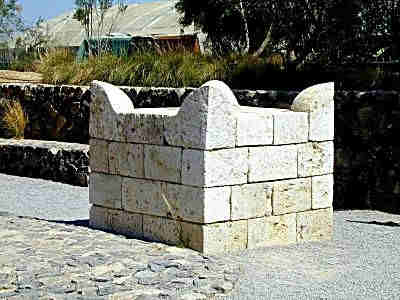
Another Israelite temple was excavated at Tel Arad (20 mi. east), including an ancient horned altar, a holy place & a holy of holies. (I left my scriptures there while on tour in 1999--perhaps my only proselyting, as a Mormon in the Holy Land!) It is the only fully-excavated Israelite temple in the world, built by Solomon and used until the times of kings Hezekiah or Josiah (2 Kings 18).

These mosaics in our JC (on loan from the Israeli Antiguities Authority) came from the floor of public bldgs. in ancient Be'er Sheva.


Be/er sheva marked the southernmost extent ot Israel's kingdom, hence the phrase "from Dan to Beersheva" describing the entire kingdom. Abraham, Isaac and Jacob all lived there. Today, it is a modern industrial city -- the "Capital of the Negev Desert." Its 200,000 population makes it the 7th largest city in Israel. It has "blossomed as a rose" from the mainly dry and sterile northern Negev.


The Turkish Ottoman Empire controlled the area for 300 years (until WW I) and built many facilities--like this handsome building (now privately owned). There is also a Turkish cemetery and monument nearby.


General Edmund Allenby was a hero of World War I in the Middle East. In 1917, UK and Australian forces overran the defenses with horses & bayonets, capturing Beersheva in the "last successful cavalry charge in British military history."


On the edge of town is a peaceful, beautified UK/Australian cemetery.


 During Israel's 1948 War for Independence, its military took Beersheva from the Egyptians and other Arabs. On the highest hill above the city is the modernistic Negev Brigade Memorial honoring those fallen soldiers.
 Views of Beersheva from there are the very best--even in a heavy cloud cover.
Not far from the McDonald's home where we held Church is David Ben-Gurion University, including its large medical center (left below).


 The nearby Beersheva courthouse and civic center is also very modern.
 The downtown area is a mixture of modern and "Old Town" (note the Roman aqueduct). Beersheva's growth has been largely Jewish, including many immigrants from Ethiopia and the former Soviet Union. A thriving industrial and military center, its growth is pushing the suburbs further to the south and west. Below (right) is a nicely planned community, including a regional playground and park.


Be/er sheva marked the southernmost extent ot Israel's kingdom, hence the phrase "from Dan to Beersheva" describing the entire kingdom. Abraham, Isaac and Jacob all lived there. Today, it is a modern industrial city -- the "Capital of the Negev Desert." Its 200,000 population makes it the 7th largest city in Israel. It has "blossomed as a rose" from the mainly dry and sterile northern Negev.


The Turkish Ottoman Empire controlled the area for 300 years (until WW I) and built many facilities--like this handsome building (now privately owned). There is also a Turkish cemetery and monument nearby.


General Edmund Allenby was a hero of World War I in the Middle East. In 1917, UK and Australian forces overran the defenses with horses & bayonets, capturing Beersheva in the "last successful cavalry charge in British military history."

On the edge of town is a peaceful, beautified UK/Australian cemetery.


 During Israel's 1948 War for Independence, its military took Beersheva from the Egyptians and other Arabs. On the highest hill above the city is the modernistic Negev Brigade Memorial honoring those fallen soldiers.
 Views of Beersheva from there are the very best--even in a heavy cloud cover.
Not far from the McDonald's home where we held Church is David Ben-Gurion University, including its large medical center (left below).


 The nearby Beersheva courthouse and civic center is also very modern.
 The downtown area is a mixture of modern and "Old Town" (note the Roman aqueduct).

We enjoyed our day together and will retain many warm (but windblown) memories of Beersheva.


No comments:
Post a Comment