[See April '11 post, Senior couples - Service & fun.]
In order to attend Nov. 2010 & May 2011 Humanitarian Conferences in Amman, Jordan, we first obtained visas from the Jordanian Embassy -- requiring a full-day trip to Tel Aviv-Yafo. The name "Tel" is an archaeological hill, with newer civilizations layered atop older ones. "Yafo" = Jaffa -- one of the world's oldest seaports, and now part of this modern city. Jaffa was named for "Japeth" -- Noah's son, said to have founded the ancient port. (Now, that is really old.) "Aviv" is Hebrew for "spring," for renewal. So, literally it is "spring hill." This old city is very modern & thriving--the business and financial capital of Israel. Its economy ranks 2nd in the Middle East and 50th globally.


Jordan is only the 2nd Arab country after Egypt to normalize relations with Israel. So reciprocal visas between those nations is unique. Jordan's embassy is in a modern high-rise office bldg. on 14 Aba Hillel, Ramat Gan (below left). In Nov. we wandered there after blindly following our misguided GPS into a nice quiet suburb. In May, we ditched the GPS for a good map.


 After paying a hefty exit fee to leave the country ($94 for both of us), we passed through customs inspection. Our bags were stored--but we had no further access until boarding the bus. In Nov. we waited 3 hours for the last bus of the day to arrive. Since our cell phones could not make int'l calls, a friendly Jordanian from the U.S. called his brother to explain our plight to Mike Boyd. The bus delay was due to: (i) the motorcade of Palestinian Pres. Abbas, (ii) lack of passengers from Jordan to Israel taking the bus, and (iii) the driver's failure to stop his empty bus at a checkpoint--thus, sending him back again to do it right.
 Finally we reached the famed Allenby Bridge border crossing -- also called the King Hussein Bridge by Jordanians. It was surprisingly small, as was the Jordan River at that point. Irrigation and upstream damming have reduced it to a mere trickle. (The Israeli and Jordanian borders are only 5 KM apart.)
 Arriving after dark at the Jordanian customs station in Nov., our real fun began. We were herded inside, along with 30 bus passengers. (Only 3 of us endured the entire 3-hour wait). While on the bus, an immigration agent collected all passports. That soon became a problem.
The passports were randomly stacked in front of a window--then passed along to a 2nd window. There, an agent checked his computer and called out the 1st name on the passport. If the person heard the name in that noisy crowd and responded, it was passed thru a hole in the wall back to the 1st window. (Otherwise, the passport went to the bottom of the pile.) The agent at the 1st window then checked his computer--and again called the person's name. Marilyn was the last person thru -- and her name was never called. That is because her passport (in a blue cover) had been given to a Canadian woman whose 1st name was probably similar. So we were shown to a lounge and asked to wait "just a few minutes." Somewhat later, the Canadian returned for her passport (in a red cover), and we were finally on our way. Below are photos of these memorable sites -- all taken on our return trip, when no crowd was there.


On 5/7/11 we sailed thru Israeli customs and found our bus to Jordan waiting just outside! We arrived at customs in just 1/2 hour & waited on the bus while passports were checked. After our bags were checked, they called out names just once. If a name wasn't heard, a Jordanian customs agent personally delivered passports to those waiting -- by matching photos with faces. Time spent was only two hours [11 am to 1 pm] from leaving our JC until clearing Jordanian customs!


A Banana Plantation. En route to some Jordan River sites, we made our first stop. We picked some ripe bananas and avoided a dead snake.


Jordan River & Jesus' Baptismal Sites. Most scholars believe that Jesus was baptized by his cousin John in the south Jordan River near where it enters the Dead Sea. In the distance below are the river's west bank, Jericho and the Dead Sea.




After a long, hot one-mile walk, we reached a shady shelter, where the guide explained more of this area's ancient history.

Sharon Eubank examined how an arm or tributary of the Jordan historically may have been a quiet location for the Lord's baptism.

Wadi al-Kharrar is the most commonly accepted baptismal site, at a tributary about one mile east of the Jordan River. Two Popes and other top Christian leaders have visited this site -- including John Paul II in 2000.


Jordan's Dept. of Antiquities has promoted extensive archaeological excavations in an area filled with early ruined churches -- many still underway.

Today, Jordan's govt. has also offered free land to Christian churches willing to build -- in order to develop the area. This recent, beautiful Greek Orthodox Church of St. John the Baptist is a recent example.


More churches were still under construction, as seen on the horizon.

Jordan support for a Christian population that is dwindling elsewhere in the Middle East was very impressive.
*****************************
Le Royal Hotel. One reward for coming to each conference was staying in this elegant 24-story, 5-star hotel originally built with Iraqi money.


Right in the center of Amman, it had gorgeous marble walls & floors, dark hardwood, thick carpets & luxurious rooms with a huge comfy bed. (No crashing into each other here.)


Opening our curtains the first morning in Nov. '11, we saw this panorama -- not quite as spectacular as our daily view of Jerusalem. (Note our tall hotel's shadow.) Amman has over 2 million people. Along with Irbid, where the Lees are assigned, nearly half of Jordan's entire 6 million population lives here.


The following night, we ate at a fine Chinese restaurant, joined by the Hallstroms -- Elder Donald, wife Diane and daughters Erin and Kara. They had made the border crossing from the JC in just 90 minutes!

In May, we had a superb evening meal with other senior couples at Le Royal.


Marilyn saw this rotating piano with its own scrolling music. She was envious!


Each morning, fresh flowers showed up in the gleaming hotel lobby.


One afternoon, we walked down "Embassy Row" on the same street as our hotel.


Many Jordanian soldiers guarded these sensitive facilities during Nakba week.


On another afternoon, we traveled north to visit a water project supported by LDS Charities. It is providing fresh water to the town of Juba and surrounding areas. Unlike another prior failed project, this one is much more accessible, better managed and self-sufficient -- with clearer authority & accountability.


We were attended by the town mayor (also a sheik, left), the project manager and technician (center) and a translator (Amir, local LDS member, on the rt.).

Of course our sole reason for coming, both times, was to receive training & inspiration from SLC leaders -- mainly Dave McMillan (DTA) & Sharon Eubank (CHaS. In Oct. '11 she was head of LDS Charities ). Also, to enjoy the comaraderie of other senior couples, to share both unique & common experiences, and to learn what works & doesn't work.


Each day, sumptuous meals were prepared and served by the host couples and helpful sisters. Eating on the "Jeffrey Holland Memorial Lawn" (manicured and greened by Elders Boyd and Youngberg) almost took us back to the USA.


In Nov. '10 the other senior service couples (left to rt. below) were the Lee's (Jordan), Burton's (Egypt), Mattis' (Syria), Boyd's (Jordan) and Eastly's (Lebanon). Elder Hallstrom & Dave McMillan are on either side of me. All except the Lees were gone by our next conference, May 2011.

In May '11, the following attended the conf. (to the rt. of us & Dave McMillan): Chris & Bobbie Coray (Syria), Brent & Ruth Youngberg (Jordan), new District Pres. Karim Assauod (Lebanon), Alain & Danielle Marie (Lebanon), Jim & Karyn Anderson (Lebanon), Brent & Charlene Lee (Jordan) and Elder Paul Pieper.

Both times, we met in the rented LDS Amman Center -- a former Swiss embassy. Its spacious, well-appointed rooms have served us well for nearly 20 years. But soon, the Church hopes to acquire its own property in Amman.


The owner is an architect who has lived in Chicago. He designed it himself and is holding it for us. The back side (bottom) is nearly as grand as the front (top).


Jordan has now recognized the Church's right to own property. This property can be acquired as soon as Parliament grants a permit for it to be used as a church. We were very impressed with its beauty and its upscale neighborhood.


By early afternoon we adjourned for our return trek. And another marathon?
In Fall '11, BYU & the Church decided we should not attend conf. in Jordan again Instead, Jim Kearl & Sharon Eubank separately did hands-on training at the JC.
In order to attend Nov. 2010 & May 2011 Humanitarian Conferences in Amman, Jordan, we first obtained visas from the Jordanian Embassy -- requiring a full-day trip to Tel Aviv-Yafo. The name "Tel" is an archaeological hill, with newer civilizations layered atop older ones. "Yafo" = Jaffa -- one of the world's oldest seaports, and now part of this modern city. Jaffa was named for "Japeth" -- Noah's son, said to have founded the ancient port. (Now, that is really old.) "Aviv" is Hebrew for "spring," for renewal. So, literally it is "spring hill." This old city is very modern & thriving--the business and financial capital of Israel. Its economy ranks 2nd in the Middle East and 50th globally.

Jordan is only the 2nd Arab country after Egypt to normalize relations with Israel. So reciprocal visas between those nations is unique. Jordan's embassy is in a modern high-rise office bldg. on 14 Aba Hillel, Ramat Gan (below left). In Nov. we wandered there after blindly following our misguided GPS into a nice quiet suburb. In May, we ditched the GPS for a good map.

Days of Remembrance & Disaster. On 5/2/11, while on the freeway to Tel Aviv for our Visa renewal, a siren sounded at 10 am. Suddenly, we were the only car moving! All others had pulled off the road and Jewish occupants got out to stand in silence for two minutes--in tribute to the holocaust victims. It was really quite moving. On 5/9/11 the Jews did this again on their Memorial Day, honoring all soldiers who died in wars, starting with the 1947-48 Arab-Israeli War for independence. That always comes one day before the Jewish Independence Day, which in 2011 was on May 10 (on the Jewish calendar). BUT on May 15 (the actual anniversary on the Gregorian calendar), Palestinians will observe their "al-Nakba" (Disaster Day) for the very same 1948 event -- creation of an independent Jewish state and displacement of many Palestinians after Israel was invaded by 5 nations but eventually won the war.
At the Jordanian Embassy, on both Nov. 2 and May 2, we were attended courteously amid photos of King Hussein and Yitzak Rabin (who signed their peace accord in 1994 with Pres. Clinton) and King Abdullah II -- the current monarch and his Palestinian wife Rania.


In Nov. we had a 3-hour wait for the visas (a simple stamp inside our passports, costing us $47 each, good for 3 mos.) In May the price went up to $59 but we waited only 1-1/2 hours. Meanwhile, we strolled along Abba Hillel. Tel Aviv's building styles & sizes are much more varied than Jerusalem and its limestone.


Both times we enjoyed a terrific & inexpensive Italian made-to-order luncheon at Ritanga, before returning to pick up our passports and leaving this modern metropolis --now 1/2 million population (over 1 million including suburbs).


Journey to Amman
On 11/8/10 we made our marathon trip from Jerusalem to Amman. How can it take nearly 7 hours to travel just 45 miles? We started at the clean, modern Israeli customs and immigration border station. So far, so good.

Again, we saw photos of the 1994 peace partners, alongside King Abdullah II with wife Rania, and King Hussein with his American wife, Queen Noor.


 After paying a hefty exit fee to leave the country ($94 for both of us), we passed through customs inspection. Our bags were stored--but we had no further access until boarding the bus. In Nov. we waited 3 hours for the last bus of the day to arrive. Since our cell phones could not make int'l calls, a friendly Jordanian from the U.S. called his brother to explain our plight to Mike Boyd. The bus delay was due to: (i) the motorcade of Palestinian Pres. Abbas, (ii) lack of passengers from Jordan to Israel taking the bus, and (iii) the driver's failure to stop his empty bus at a checkpoint--thus, sending him back again to do it right.
  Finally we reached the famed Allenby Bridge border crossing -- also called the King Hussein Bridge by Jordanians. It was surprisingly small, as was the Jordan River at that point. Irrigation and upstream damming have reduced it to a mere trickle. (The Israeli and Jordanian borders are only 5 KM apart.)
 Arriving after dark at the Jordanian customs station in Nov., our real fun began. We were herded inside, along with 30 bus passengers. (Only 3 of us endured the entire 3-hour wait). While on the bus, an immigration agent collected all passports. That soon became a problem.
The passports were randomly stacked in front of a window--then passed along to a 2nd window. There, an agent checked his computer and called out the 1st name on the passport. If the person heard the name in that noisy crowd and responded, it was passed thru a hole in the wall back to the 1st window. (Otherwise, the passport went to the bottom of the pile.) The agent at the 1st window then checked his computer--and again called the person's name. Marilyn was the last person thru -- and her name was never called. That is because her passport (in a blue cover) had been given to a Canadian woman whose 1st name was probably similar. So we were shown to a lounge and asked to wait "just a few minutes." Somewhat later, the Canadian returned for her passport (in a red cover), and we were finally on our way. Below are photos of these memorable sites -- all taken on our return trip, when no crowd was there.


At nearly 6 pm, our driver was the ever-patient Elder Brent Lee. He had replaced Elder Mike Boyd, who had started waiting several hours for us, starting at 1 pm. In the end, the drive to Amman after dark went uneventfully. We arrived in time for dinner at 7 pm.
On 5/7/11 we sailed thru Israeli customs and found our bus to Jordan waiting just outside! We arrived at customs in just 1/2 hour & waited on the bus while passports were checked. After our bags were checked, they called out names just once. If a name wasn't heard, a Jordanian customs agent personally delivered passports to those waiting -- by matching photos with faces. Time spent was only two hours [11 am to 1 pm] from leaving our JC until clearing Jordanian customs!
In the waiting van was Sharon Eubank & some new friends: The Youngbergs (replacing the Boyds in Amman) & the Corays -- just removed from Syria, due to unrest there. With some extra time, we took a fascinating side-trip to Amman.

A Banana Plantation. En route to some Jordan River sites, we made our first stop. We picked some ripe bananas and avoided a dead snake.

Jordan River & Jesus' Baptismal Sites. Most scholars believe that Jesus was baptized by his cousin John in the south Jordan River near where it enters the Dead Sea. In the distance below are the river's west bank, Jericho and the Dead Sea.

Because this area marks the start of Jesus' mission and Christianity itself, it may be one of the holiest sites in the world -- like places of his birth, death & resurrection.
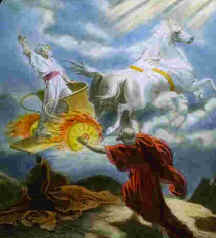
Nearby, the then-large Jordan River may have been successively parted by Joshua (Josh. 3), Elijah and Elisha (2 Kings 2). Also nearby is Elijah's Hill, where that prophet may have gone to heaven in a chariot of fire.

Jesus was baptized by his cousin John "in Beth-a'-bara beyond [east of] Jordan." (See John 1:28, 10:40; 1 Ne. 10:9). Unlike the idealized Yardenit baptismal site near the Sea of Galilee, this area is desolate and near the lowest point on earth -- over 1000 ft. below sea level. The ground is dry and chalky. Vegetaton is sparse, except at the muddy river. The air is normally thick and hot, with insects -- anytime but winter. Truly, Jesus would have "descended below all things" to be baptized in this area (D&C 88:6, 122:8).
We followed this narrow, winding path past a spring that may have supplied some needs of John the Baptist.

After a long, hot one-mile walk, we reached a shady shelter, where the guide explained more of this area's ancient history.

Sharon Eubank examined how an arm or tributary of the Jordan historically may have been a quiet location for the Lord's baptism.

Wadi al-Kharrar is the most commonly accepted baptismal site, at a tributary about one mile east of the Jordan River. Two Popes and other top Christian leaders have visited this site -- including John Paul II in 2000.

At the west bank of the Jordan River was a larger, more developed site. That spot was the loveliest (and coolest) part of our trek on that very hot day.


Jordan's Dept. of Antiquities has promoted extensive archaeological excavations in an area filled with early ruined churches -- many still underway.

Today, Jordan's govt. has also offered free land to Christian churches willing to build -- in order to develop the area. This recent, beautiful Greek Orthodox Church of St. John the Baptist is a recent example.


More churches were still under construction, as seen on the horizon.

Jordan support for a Christian population that is dwindling elsewhere in the Middle East was very impressive.
*****************************
Le Royal Hotel. One reward for coming to each conference was staying in this elegant 24-story, 5-star hotel originally built with Iraqi money.

Right in the center of Amman, it had gorgeous marble walls & floors, dark hardwood, thick carpets & luxurious rooms with a huge comfy bed. (No crashing into each other here.)


In May, we had a similar panorama on the opposite side of the hotel.

We also ate extremely well here. Breakfasts were worth arising early for omelettes, cereals, fruits and other delicious cuisine.


On our first night in Nov., we dined with our group of six service couples plus our SLC leaders at a Jordanian/Indian restaurant.

The following night, we ate at a fine Chinese restaurant, joined by the Hallstroms -- Elder Donald, wife Diane and daughters Erin and Kara. They had made the border crossing from the JC in just 90 minutes!

In May, we had a superb evening meal with other senior couples at Le Royal.

Marilyn saw this rotating piano with its own scrolling music. She was envious!


Each morning, fresh flowers showed up in the gleaming hotel lobby.

One afternoon, we walked down "Embassy Row" on the same street as our hotel.

Many Jordanian soldiers guarded these sensitive facilities during Nakba week.

On another afternoon, we traveled north to visit a water project supported by LDS Charities. It is providing fresh water to the town of Juba and surrounding areas. Unlike another prior failed project, this one is much more accessible, better managed and self-sufficient -- with clearer authority & accountability.

We were attended by the town mayor (also a sheik, left), the project manager and technician (center) and a translator (Amir, local LDS member, on the rt.).

Of course our sole reason for coming, both times, was to receive training & inspiration from SLC leaders -- mainly Dave McMillan (DTA) & Sharon Eubank (CHaS. In Oct. '11 she was head of LDS Charities ). Also, to enjoy the comaraderie of other senior couples, to share both unique & common experiences, and to learn what works & doesn't work.


We passed by the new bldg. and found the owner outside, caring for his flowers.


Jordan has now recognized the Church's right to own property. This property can be acquired as soon as Parliament grants a permit for it to be used as a church. We were very impressed with its beauty and its upscale neighborhood.


On our last day at the Amman Center, each conference concluded with inspired instruction and a brief testimony mtg. -- followed by interviews with Elder Hallstrom (Nov.) and Elder Pieper (May), then another great final backyard BBQ.

Yep. At least -- it was in Nov. '10.
One hour to reach the Jordanian customs (incl. some Amman stops).
Two hours cross the border to Israel`-- including waiting behind a full bus, both before and after unloading for passport checks and inspection for on-board explosives plus the legendary Israeli interrogation of us as "volunteers."
One hour via sheroot (shuttle bus) to the Jerusalem cab station.
One hour before an outside taxi ordered by JC security got us back home.
Next time, "forewarned is to be forearmed."
Was it all worth it? Yes--definitely! It went much easier in May!

No comments:
Post a Comment