Eid al-Adhar
 We returned from our Jordan Conf. mid-Nov. '10, on the first day of Eid al-Adhar ("Festival of Sacrifice"). It began 70 days after Eid al-Fitr, ending the month of Ramadan & lasting until sunset 3 days later. We were surprised to see so many fireworks near the JC in East Jerusalem.
 This was a "solemn festival" commemorating Abraham's willingness to sacrifice his son (Ishmael, for the Muslims) and submit to God's will. Like Jacob (re-named "Israel" by God), Ishmael also had 12 sons -- fathers to the Arabs, much like the 12 tribes of Israel.
The festival begins with a prayer of dedication & sermon, ending with a great feast & gifts. As God provided Abraham with a sacrificial ram to replace his son (Ishmael?) -- so also, lamb meat is divided into thirds: One part for the poor, one part for close family or friends & one part for immediate family.


This festival comes during the annual hajj pilgrimmage to Mecca -- one of the five pillars of Islam. Hajj honors Mohammed's victorious return from Medina, after his earlier expulsion from Mecca by the rival Quraysh tribe. For one week, throngs of pilgrims trek to their holy city from al-Nour mtn. (where, in a cave, an angel visited Mohammed to start Islam).


Their destination is the Ka'aba, a 42-foot cubed black bldg. -- holiest shrine in Islam. Muslims all pray in its direction -- not because it is an idol but for what it represents. Muslims believe it is on the site of Adam's 1st altar, destroyed by the flood. After Abraham left Ishmael & his mother Hagar in the desert, they ran out of water. Angel Gabriel opened a spring for them (called "Zamzam"). (See Genesis 21.) Mecca was built on that same site. When Abraham later visited his family there, he built the Kaaba as a shrine to thank God. During the hajj, millions of Muslims circle the Kaa'ba seven times, walking counter-clockwise -- to honor Abraham & his posterity, including Mohammed -- who cleansed the Kaaba of false idols & rededicated it to God (Allah).

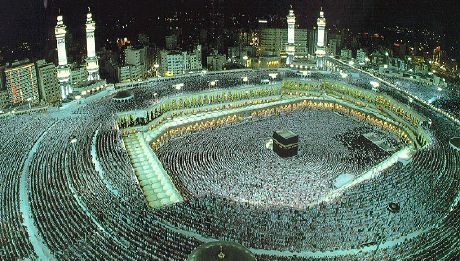
 Within the eastern cornerstone of the Ka'aba is the Black Stone. Muslims believe it was a meteorite from heaven marking the spot of Adam's first altar. After the flood, Gabriel showed it to Abraham, who then had Ishmael place it in the Ka'aba. As all pilgrims cannot kiss the stone like Mohammed did, they point to it each time they circle the Ka'aba during hajj. (Note: The Ka'aba's 4 corners face the 4 points of the compass.)
Next time, for Ramadan/Eid al-Fitr & Hajj/Eid al-Adhar in Sept. & Nov. '11, we won't be as surprised by the fireworks!


Arab Night at the JC. Soon after these religious holidays for Muslims & Israelis (i.e., High Holy Days & Sukkot), our students enjoyed some interesting Arab & Jewish evenings.
In Oct. 2010 and May & Sept. 2011, "Arab Nights" started with talks by the JC Arabic instructor -- Ayman Jabrara.

Al Aksa Muezzins. They introduced the young "muezzin" Firras & his father Najib -- both sheiks. They make the 5 daily calls to prayer at the Al Aksa Mosque on the Temple Mt. Jordan's King pay for them & others.


The young muezzin had memorized the entire Qu'ran by age 9. This may be a gift of God, conferred on the eldest (or other worthy) sons in a muezzin's family. Firras' father had that same gift, as did each generation in the same family for 500 years! The Qu'ran's poetic form -- with each line being a complete thought -- makes it easier to understand & memorize.

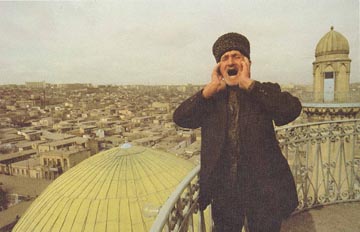
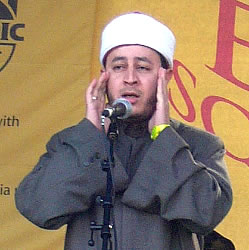
Prayer Positions. Three positions are prescribed: standing, kneeling and head to ground. Women pray behind -- so the men are not distracted. Sick or aged persons may pray in bed or sitting down. After 5 minutes or formalized prayer -- usually in a group -- personal prayers may be offered. Each ends with Amen -- just like Jews or Christians. Fridays are for group mid-day prayers.


 After a thoughtful discussion of many Islamic practices, we were treated to a dinner prepared by the JC kitchen chef Jamil (seen left as moving very fast) & Ahmed. The Eid al Fitr feast follows Ramadan and Eid al Adhar is in the month of Dhu al-Hijjah (the hajj pilgrimmage to Mecca).

There were many delicious courses of salads, kebobs (chicken and lamb), upside-down makluba (rice with spices and meat), etc. and desserts.


On 5/25/11 students came in Arab attire -- from their field trip to Turkey.

Likewise, on 9/28/11.


And again on 2/1/12.


After dinner (Oct. '10) came Arab dancing led by a young Palestinian.


All ages and groups were included. Great fun!


*******************************
Arab Concert and Tours at the JC.
Although mostly Israelis come to our JC tours and concerts, we warmly welcomed any Arabic groups. On 3/2/11 more than 50 teachers from several schools came to a tour -- due to efforts by the Beit Safafa Women's Society, near Bethlehem. They were very interested but quite vociferous.


On 5/5/11 we hosted the Edward Said Conservatory in East Jerusalem for an evening concert. About 100 young Arab artists (ages 6 to 18) performed or received certificates of recognition.


The hall was nearly filled with appreciative families and friends. Afterwards, I invited all to come for our 24 regular one-hour JC tours each week. 


___________________________________________________________
Israeli dancing.
There was Israeli fun at the JC on Friday, 10/22/10. A lively Jewish instructor formed large and then smaller group circles, to do both traditional and modern ethnic dances.


Jewish Passover ("Pesach") / Seder Meal
Each term of students have a full passover experience -- so that each can experience a fundamental Jewish religious rite. On 10/14/10, it came 6 months before the true date. Ophir Yarden (JC's Hebrew instructor) conducted & explained every step of it. The ancient text is in the Haggadah. It narrated the Jews' liberation from bondage in Egypt, using portions of the Talmud with special blessings, rituals & Passover songs.


Unlike some public occasions, the Passover meal or "Seder" is normally celebrated in homes, with fine table settings and holiday clothes. It is a time for praise, thanksgiving & rededication. Everyone participates.

The first rite involved a plate of simple symbolic foods, a glass & a bottle of wine (or grape juice, in our case). There were two bitter herbs (radish & romaine lettuce) denoting harsh slavery, a non-bitter herb (parsley) to be dipped in salt water denoting years of tears, a paste of nuts & fruits like the mortar used for bldgs in Egypt, a chicken or lamb bone for the temple sacrifice & an egg for life. All were eaten in a definite order per the Haggadah ritual. Wine (juice) was drunk four times during the ritual, as specific blessings or charges were invoked.


The matzah bread (unleavened and tasteless, even burned and broken) was eaten to celebrate deliverance in haste from oppression. Much of the text was sung by different groups of student participants.


The washing of hands occured before eating the symbolic foods & also the true feast that followed. We had a delicious multi-course meal, with two preceding the main plates shown & two more following them.


Following the feast, a blessing was invoked. Then, to keep their interest, the children did the "afikomen" (a kind of treasure hunt), to search for the broken matzah bread & one more hidden delight. This time, Amanda Judd was the lucky girl to find a box of chocolate, which she gladly shared with others.


Each BYU group gets to do a seder meal. On 10/10/11 our students really got into their singing, to the crowd's great delight.


At our table sat Nino Zohar, a committed Jew who does all my Hebrew translations. She had a great time, as did the rest of us.


Ophir again talked us thru every step of the 3-hour Seder evening.

This time, after the Afikomen treasure hunt (found by a BYU student), they did a fun "Jerusalem rap" song -- much to Ophir's pleasure.


Students did another fun "Passover Rap" to close out the evening on 2/16/12.

*******************************
Synagogue evening services.  On 10/29/10 (Fri.), we and about 25 of this term's students visited a conservative, modern synagogue near Hebrew University on French Hill. Most of the service was sung and spoken in Hebrew. The rabbi (actually, a "rabbah") was a young mother. Many explanations were given in English, as the services were fairly "Americanized." We were recognized and warmly welcomed both before and after the service. No photos were allowed inside, but this shows our group outside as we left after dark -- inspired and enlightened.
2nd Synagogue Visit. On Fri. 2/19/11 we visited a more Orthodox synagogue with 20 of our winter-term students. This time, Ophir Yarden (a Hebrew instructor at the JC) came to his own synagogue. In advance, he explained the services and provided a very helpful written liturgy (in both English and Hebrew).

Ophir also brought his young son. He had come to our apt. on Halloween for trick-or-treating. The boy was shy but bright and charming.


___________________________________________________________
Christian -- The Last Supper
During the Passover season -- holiest for the Jews -- Jesus met with his apostles for their Last Supper. It was in an upper room of a nice villa in upper West Jerusalem on Mt. Zion. By tradition, that was "the Cenacle" -- a structure next to the possible tomb of King David.


Traditionally, this same villa was also where the apostles saw the resurrected Lord, elected Matthias to replace Judas and received the Holy Ghost on the Day of Pentecost (Acts 1:13). We went there on a blustry day in December.
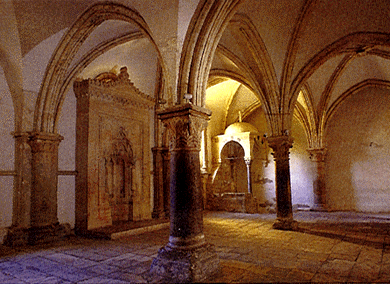

 Jesus carefully planned the events far in advance, not telling his apostles much. The table setting was likely in a Roman triclinium -- where persons reclined on their left side, on cushions next to low couches. This setting was re-enacted in our auditorium / chapel for a sacred service on the last Sabbath evening before students left in Dec.
 The Lord's Last Supper was a special seder meal -- likely dipping pita bread into a kind of lamb stew, preceded by the usual seder eggs, unleavened bread, bitter herbs, fruits, nuts & wine. It also included the Lord's teachings, the sacrament and his Great Intercessory Prayer.
After a lecture by Jeff Chadwick, students read scriptures from John 13 thru 17, followed by Kent Jackson's lecture. [At the 4/16/11 program, senior couples read them. We got to do John 15.] We pondered these holy events during 15 minutes of silence as lights dimmed. The organ softly played at the end. The spirit permeated -- as evening turned into night & the city lights appeared.


[See also Sept. 2010 post, Religious Holidays & Practices -- Muslim & Jewish,
and Dec. 2010 post, Last Days of Jesus]
and Dec. 2010 post, Last Days of Jesus]

No comments:
Post a Comment