Our 12/4/11 field trip with students had both some high adventure atop the legendary Masada desert fortress and a minor mishap at the Dead Sea.


Masada ("stronghold"). This was the last bastion of Jewish rebels after Jerusalem & its 2nd Temple were destroyed by Romans in 70 AD. It is a dramatic, isolated 40-acre mesa in the eastern Judean desert -- 1,400' above the Dead Sea. It was first fortified by Hasmoneans after 100 BC. Its only access was the Snake Path on the east-side cliff -- easy to defend.

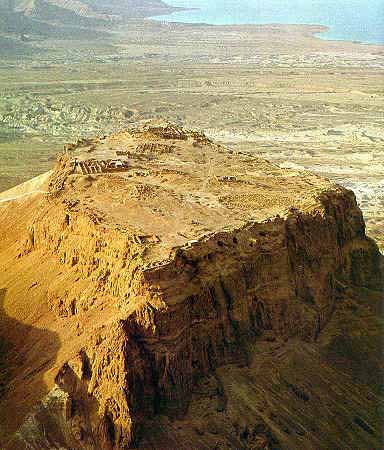
Today, that same sheer side is more easily accessed by cable car.


In 1981, we descended that same steep Snake Path -- ultimately, in the dark. Israeli military had to shine strong searchlights from afar to get us safely down.


We were led by Dr. Eric Huntsman, who brought his daughter Rachel.

The Commandant's HQ, next tothe main eastern entry, controlled traffic to all points on Masada and the passage of supplies.


Our tour started at the Northern Palace, built about 33 BC on 3 high terraces. Herod had the upper level; the lower two were for guests & receptions. Originally, Herod in 40 AD had left his family at Masada for safety while he went to Rome to be named king of Judea by his patron, Mark Anthony.
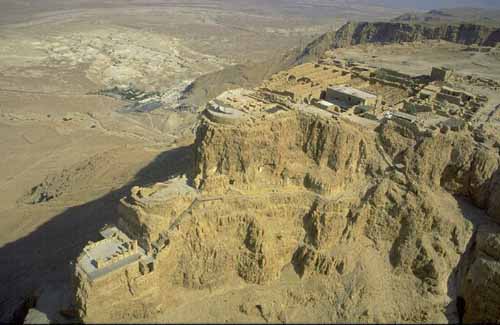
The central roofed hall had columns, mosaics and great views.


That was a good place for a group photo.

Inside residential rooms were some walls with colorful frescoes. Original construction was shown below the black lines; reconstruction was above.


Blackbirds & we enjoyed the views and the cool morning breeze.


To the east was sediment from the ancient Dead Sea, scored by cracks.

The middle terrace below had a circular palace and halls. A model showed how the fortress looked in its prime. The black channels diverted flood waters into 12 large cisterns on the rocky slopes -- able to hold 120,000 cubic ft.!


Walking back, we saw a good profile of the palace terraces.


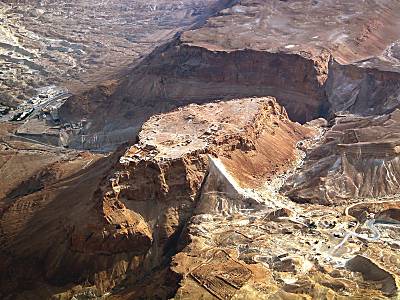
At the western base lay the Roman camps & assault ramp --built where the cliff was only 300' high. It is the most intact Roman seige system in the world.


In 73 AD, after several months' seige, Romans breached the perimeter wall. Scores of arrowheads & catapult stones ("ballistae") were discovered in caves & elsewhere. There were also many ritual baths ("mikvahs") onsite.


Hundreds of inscribed ostraca (pottery shards) were found here. Some 11 had names of those who may have drawn lots on their last night to see who would assassinate the other nearly 1,000 inhabitants -- and then each other.


The vast storeroom complex was left full of stocked food -- to show the Romans they did not starve to death but had taken their own lives.


Nearby is the only known synagogue dating from the 2nd Temple period.


Dr. Huntsman described the extremism of these rebels -- also known as Sicarii (Latin for "dagger men"). They may have plundered & killed others in Ein Gedi & other nearby settlements for supplies.


Roman baths incl. dressing rooms, hot & cold rooms with benches and frescoed walls, column drums, pools & furnaces.


Herod's Western Palace was the largest structure there (12,000 sq. ft.) Around a central courtyard was a fully self-contained complex.

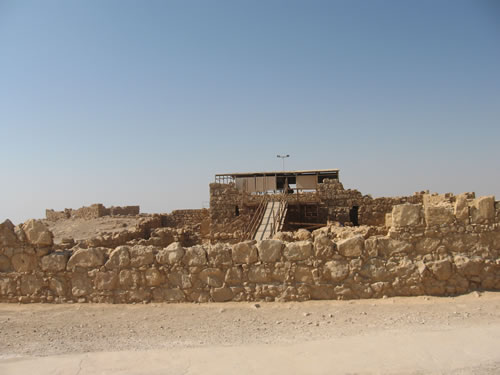

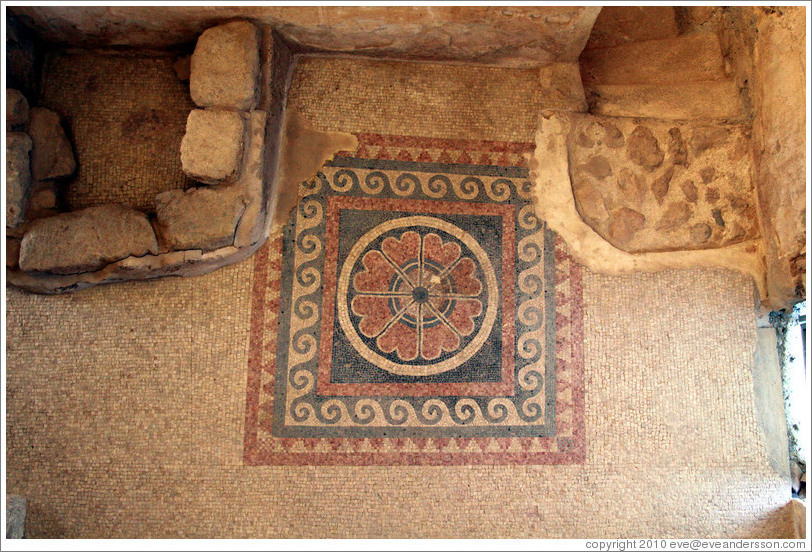
Some original vivid mosaics and frescoes were still in place.


The Columbarian was built between two Herodian lookout towers. It housed pigeons raised for food, fertilizer and sacrifice.


Byzantine Church was used by 5th to 7th century monks. Here they communed with God in isolated solitude.

Inside a Byzantine arch were floors with some richly decorated mosaics.


Some walls were adorned with pottery shards.


We viewed the Dead Sea before descending Masada to go there.


By noon, we left Masada by cable car the way we came.


As all were hungry, Andrew Zenger & all crammed into one car.

Archaeological work at Masada was started by Yigael Yadin (1963-65).


Shoreline boulders blocked entry to the water. They were encrusted with salt crystals -- hard & sharp as coral. (Some of us lacked water shoes.)


Hmmm. This beach did not slope gently into the sea. In fact it had a steep dropoff, with rocks everywhere. And waves kept getting higher. Go in ... or retreat?


Those guys seem to be having a great time. Also, Dr. Huntsman -- with his water shoes. (Too bad I didn't get that memo.)


Well, this chance may not come again. So ... they said to go in backside first. Even so, a wave got in my eyes, with a salty sting.


Once in the water, however, it was pretty fun.


Back strokes were the best -- but took me away from the starting point. Maybe better to get out, before those waves go any higher.


On reaching the shore, a big wave dashed me onto the rocks. That wasn't good for the hands or the left backside (especially knee & foot).


Matty Crandall pulled me out of the surf. He said, "You OK?" I said, "Sure."


Oh, sure! So ... how can rocks be both sharp & slick at the same time? When blood started coming faster from the arms & leg -- what next?

Next, Andrew Zenger (our HT) happened by. He walked me closer to the towel & gym shoes. By then, they were all mixed up with students' stuff.


But Cassie Pelton found & brought my gear. Before getting on my clothes in the bus, medics had me shower off some alkaline -- then applied Iodine with some knee & foot bandages. But some white residue remained the rest of the day.

Some things are only worth doing once -- or not at all.
After leaving this site, we envied some truly gentle, sandy, sloping beaches we saw elsewhere on the Dead Sea.


Ein Gedi ("goat springs"). Next stop was this oasis, located west of the Dead Sea -- between Masada and the caves of Qumran. It is a huge nature reserve -- 3,600 acres extending from the Dead Sea (1400' below sea level) to the Judean Plateau (650' above sea level).


In Bible times, David hid in a cave here (1 Sam. 24:1-2) when King Saul sought him "upon the most craggy rocks, accessible only to wild goats" (1 Samuel 24:3). When Saul entered that same cave, David cut off some of the sleeping king's robe -- proving he could have killed his pursuer.


Year-round streams flow from springs in Wadi David & Wadi Arugot (meaning "flower beds").


The rest of the group scaled these rocky cliffs to greater heights.


Marilyn & the Ohmans chose to stay at the first waterfall they found -- to admire the plants, birds & other abundant wildlife there.


Unable to climb or even sit, I stayed at the visitor's center. It was for the birds.


I did see a herd of tame Ibex come closeby.


But Marilyn's hillside shots were even better -- mainly due to good lighting.


This reserve is a sanctuary for many bird & animal species. Plants range from tropical, desert & Mediterranean. [See Dec. '10 post, Ein Gedi -- Trails of Lehi & David.]


The settlement was never very large -- consisting of a central tower, living facilities, various communal dining & assembly rooms, industrial & defensive facilities, and a very extensive water system.


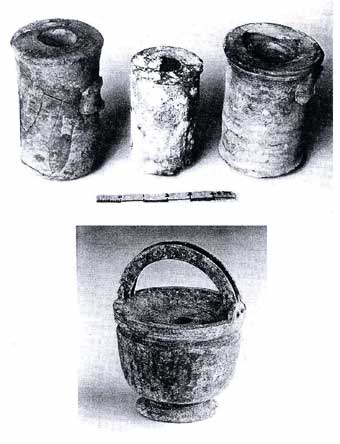
Scholars believe this was occupied by Essenes -- monastic Jews called "sons of light" who separated from the corrupt elite Sadducees & even Pharisees (rabbi-led commoners). While awaiting the final defeat of evil in a coming Messianic time, they prepared by purifying themselves & recopying scriptures. In this scriptorium room, several inkwells & lamps were discovered.


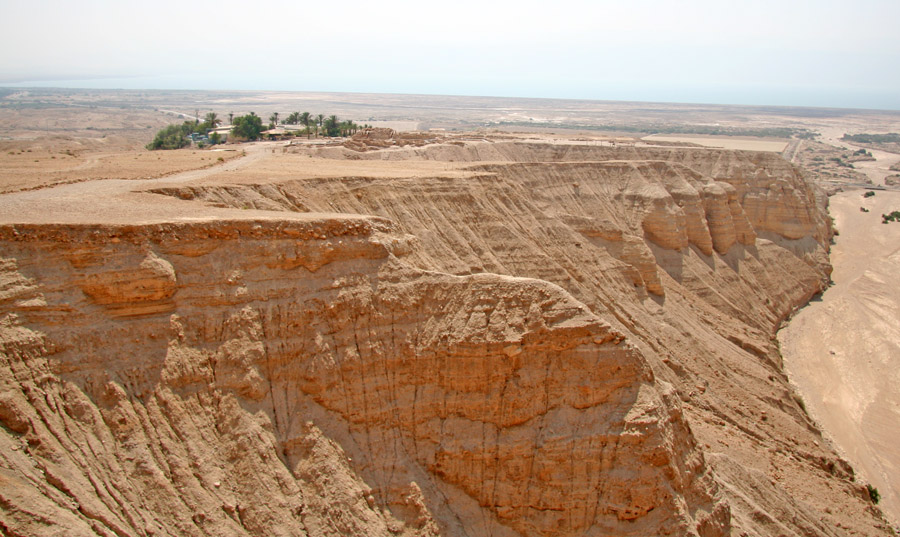
Qumran sits atop the Judean plateau, overlooking a large wadi that flooded twice each year.


Like Masada, flood water was channeled into large cisterns. Some of the smaller ones may have also been used as mikvas for ritual bathing.


After 68 AD, sons of light were destroyed by sons of darkness (Romans & others). Anticipating that, they hid these scrolls in nearby caves.

In 1947, the first scrolls were found in this cave by Bedouin shepherds.


Another 10 caves were later explored, with a total of 900 scrolls. Most of these were inside Cave 4 (found in 1952) -- cut into the cliff face by men. These are 1,000 years older than the oldest Biblical manuscripts.


As the sun set, we took a last look at this slice of ancient history.


While Masada & the Dead Sea had both highpoints & low, the day was filled with new learning, insights & experiences -- mixed with a little beauty.


We took the same trip last May. I thought it was one of our more interesting days. Fascinating history.
ReplyDeleteSorry to hear about the mishap in the Dead Sea. From your description it seems that the sea was anything but dead where you were.
ReplyDeleteHad to smile when reading that Marilyn's pictures were good "mainly because of the lighting." I wondered whether her photography skills played any part.