On 10/16/11, after exploring Zedekiah's Cave / Solomon's Quarries, we had another adventure. We often passed thru Damascus Gate (NW side of the Old City walls), with its crenellated battlements & openings. It was considered the most beautiful of all 8 gates built by Sulieman the Magnificent in 1538 AD. (Note also the defensive arrow slits in the turrets & side towers.)


We descended these stairs on the west side of Damascus gate -- and entered a unique chapter of Roman Jerusalem history.


The famous 6th century Madaba mosaic (in Jordan) showed two long Roman blvds. (each, a "Cardo") converging at Damascus gate.
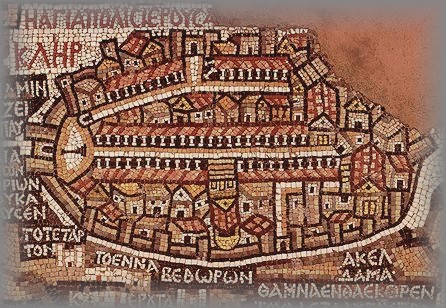
The northern gate was the easiest access point for the Old City, as it faced the only side without steep canyon slopes. It also guarded against entry by Jews into any part of Jerusalem.

The gate had three entrances, protected on both sides by massive towers & spanned by arches. This was the small east entry -- same size as the west entry, with a larger arched central entrance.

Inside the east entrance was a sizeable guard house.


Crusaders (11th century) sealed some rooms and built a new gate. In 1538 Sulieman rebuilt a new central gate using the old foundations.


In front of Hadrian's gate was a broad plaza that once held Hadrian's giant statue. Today it is a modern amphitheatre with stairway access to and from the Old City. It has seated 500 persons for performances there.


We had also noticed some Roman ruins on the east side below the main gate. Little did we know what history lay underneath.


Jerusalem had stayed in ruins for 60 years after the Roman destruction in 70 AD. In 132 AD Emperor Hadrian resolved to rebuild it. But Jewish delight turned into the 2nd Great Revolt under Bar Kochba when Hadrian said it would be built as a pagan city, for Romans only. That ended with great bloodshed. After crushing the revolt, Romans rebuilt & named the city Aelia Capitolina (after Hadrian's family).


There were side rooms for arms, ammunition & storage.


Some stones from the destroyed 2nd Temple were used in Hadrian's gate.

During the Arab period, olive presses were used here.


Stairwells were used for water cisterns. (This photo is looking up.)


Steel beams now support the bridge and gate above these rooms.


Entering the Damascus Gate, we had lunch at the Austrian Hospice -- where we met Ophir Yarden (Hebrew prof. at the JC) and his family.


No comments:
Post a Comment