See also Sept. '11 post, Turkey 1 - Istanbul]
Day 3 (9/20/11) -- The Dardanelles, Gallipoli, Troy and Canakkale
For 5 days, we traveled a long loop from Istanbul down the western coast of Turkey and then back to Istanbul along an inland route.




Troy (Greek: "Troia" or "Troas"; Latin: "Ilium," hence The Iliad.)
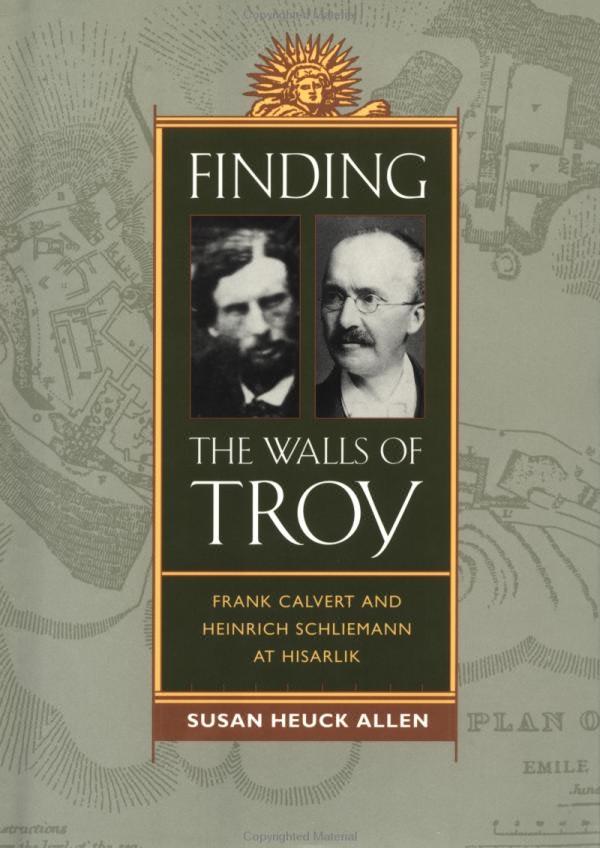 While Frank Calvert was acting British consul in Turkey, his family in 1850 acquired a large field near the NW tip of the Anatolian peninsula known as Troas or the Troad. It included part of Mt. Hisarlik -- said to be the ancient capital city of Troy. He began excavating there in 1865 In 1870 Heinrich Schliemann took over as his financial partner. Both men were pioneer archaeologists -- not yet a true science. Later experts confirmed that they had actually excavated ancient Troy. Turkey & Calvert's heirs have since sued Schliemann's heirs for a share of King Priam's fabled "treasure" that they claim he smuggled out.
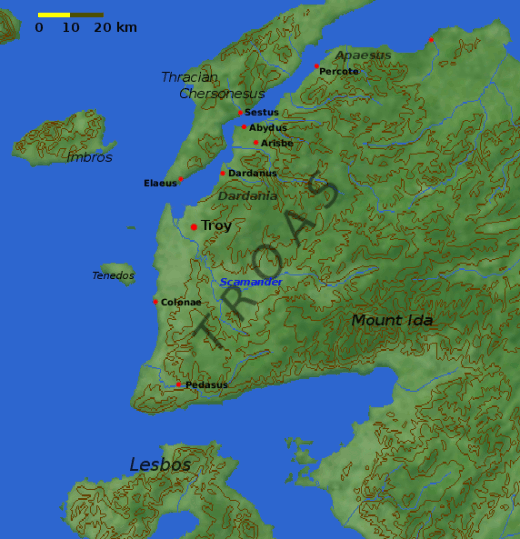
This site is now 3 miles from the water, due to centuries of persistent siltation and receding coastlines. But in ancient times, Troy became rich & powerful by controlling the Dardanelles strait and the two main rivers that converged there.





 We liked everything about this place.


 We saw local flowers & wildlife -- even Turkeys!


 As we scrambled for cover under a large tree at the very summit, lightning bolts began crashing down -- one within a mile of us. And I was holding in my hand a metal-handled umbrella (now torn to shreds by fierce, swirling winds). We felt lucky to escape alive. No one even slipped and fell on the slick, rocky hill.


We were awed by the grandeur & size of Ephesus in 1990, and were impressed again in 2011 -- like 1000's of tourists we saw. Colonades on the main entry street framed and supported many shops & public bldgs.








 St. John's apocalyptic Book of Revelation (written in exile on the isle of Patmos) begins with the Lord himself instructing John to write separate letters to each of the 7 existing branches of his church in "Asia" (all today in Turkey). Each starts with a little praise, followed by some warnings, curses & promises. Like John's gospel, Bro. Skinner believes this book was also written for endowed saints.


Sardis. We also didn't stop there. Near modern Sartmustafa, that mtn. site gathered Jews from the diaspora. They would be saved from Haman's infamous edict under Persian Xerxes II (Obad. 20, Esther 3:12-14). The Lord worried about Sardis but said it had "a few names...not defiled" that may "be clothed in white raiment" and not blotted out of "the book of life" (Rev. 3:1-6).


We slept well that night.






Day 3 (9/20/11) -- The Dardanelles, Gallipoli, Troy and Canakkale
For 5 days, we traveled a long loop from Istanbul down the western coast of Turkey and then back to Istanbul along an inland route.

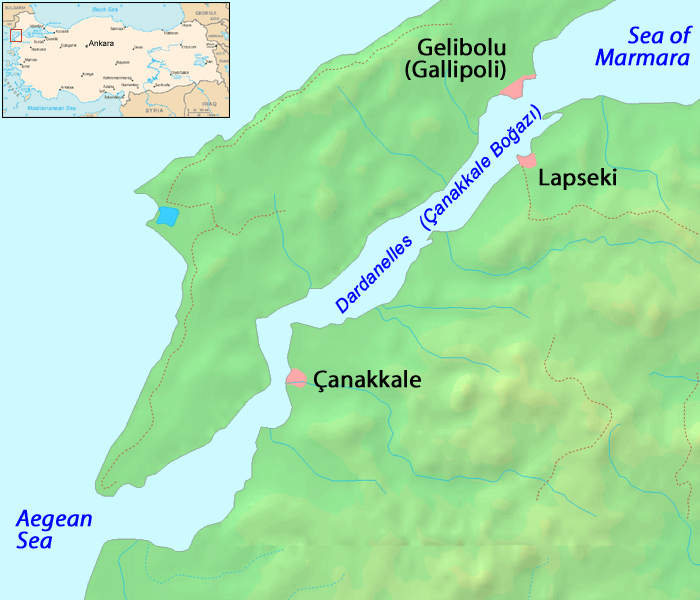
The Dardanelles. After a long bus ride from Istanbul to the Gallipoli peninsula on the European side, we ferried across this narrow strait from to mainland Turkey (in Asia). There was no bridge crossing here.


The Dardanelles connects the Sea of Marmara with the Aegean Sea. Its name (also anciently called "Hellespont") comes from Dardanus, mythical ancestor of nearby Troy.
Gallipoli (pronounced "Gal i' poli") is a very historic place. It was 1st occupied by the Turks after a devastating 1354 AD earthquake, giving the Ottoman Empire its first position in Europe. It was also involved in the 1854 Crimean War. Then in the early days of WW I, it became the scene of a major disaster for 1st Admiralty Lord Winston Churchill and the allies. Seeking to quickly knock out Turkey in the war and to secure a sea route to its ally Russia, mainly British forces attacked the peninsula in early 1915. Mustafa Kemal (Ataturk, below) heroically defended and the attack was repulsed -- the last great victory of the fading Ottoman Empire. In the 3-month campaign, each side lost over 250,000 troops. Churchill was soon removed. In contrast, Ataturk became the 1st President of the Republic of Turkey in 1924.
In the 1800's, a German amateur archaeologist & a British diplomat found that the Troy of Homer's Iliad was not just an ancient legend.
While Frank Calvert was acting British consul in Turkey, his family in 1850 acquired a large field near the NW tip of the Anatolian peninsula known as Troas or the Troad. It included part of Mt. Hisarlik -- said to be the ancient capital city of Troy. He began excavating there in 1865 In 1870 Heinrich Schliemann took over as his financial partner. Both men were pioneer archaeologists -- not yet a true science. Later experts confirmed that they had actually excavated ancient Troy. Turkey & Calvert's heirs have since sued Schliemann's heirs for a share of King Priam's fabled "treasure" that they claim he smuggled out.This site is now 3 miles from the water, due to centuries of persistent siltation and receding coastlines. But in ancient times, Troy became rich & powerful by controlling the Dardanelles strait and the two main rivers that converged there.
The Iliad tells the epic story of Troy's tragic fall after its 10-year Trojan War with Greece, mixing classic legends involving gods & goddesses with some purported history. After Paris (son of Troy's King Priam) seduced & abducted Queen Helen (wife of Menelaus, King of Sparta), Agamemnon (king of Mycenae and brother of Menelaus) led a massive expedition and seige of Troy. Many heroes died, including the Achaeans Achilles & Ajax and the Trojans Hector & Paris.
Finally the city fell, due to the Greek ruse of the Trojan Horse -- hence, the saying: "Beware of Greeks bearing gifts." Inside the huge wooden horse (hauled inside the city walls) were enough soldiers to slaughter the Trojans and destroy their city. Our students did a little re-enacting inside this giant modern wooden model erected onsite.


Extensive excavations have revealed 9 layers (and some 46 sub-levels) of ruins there, commencing in 3,000 BC. Two of the latest layers have been established as Homer's Troy in about 1,200 BC.


This may have been King Priam's palace, including much of his fabled treasure of weapons & jewelry later sold by Schliemann to the Berlin Museum.


This Eternal Trojan Stone was the largest found there (20 tons) -- perhaps used in Priam's palace. A water cave (built after 3,000 BC), recently excavated (2001), helped Troy withstand the 10-year seige. That also may be where Trojan leader Hector hid before Achilles seized & killed him. Troy's ancient walls & foundations were quite extensive.


Romans under Caesar Augustus (27 BC) thru Hadrian (150 AD) built the last city on this site as Ilium -- incl. this amphitheatre & agora. Ilium gradually declined & disappeared during Byzantine times, as the coastline continued to recede.


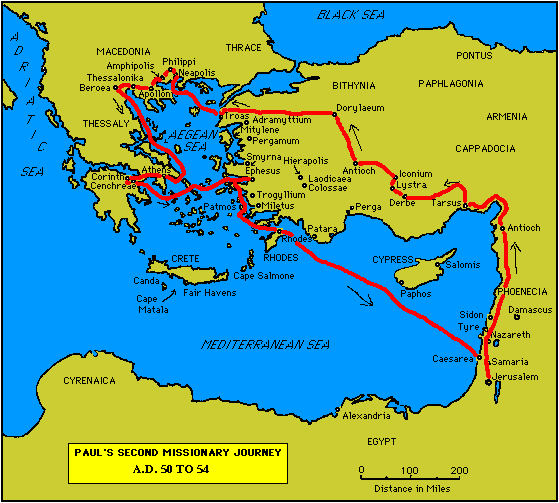
Apostle Paul at Troas. In his 2nd missionary journey with Silas, in "Troas" (either Troy or the region or a nearby port named Alexander Troas), Paul had a vision. They were "forbidden of the Holy Ghost to preach the word in Asia [Turkey]." Instead they were turned west toward Greece, where they had great success (Acts 16:6-11).
In his 3rd journey with Luke as companion, Paul performed a great miracle there. On their last day after a week's stay, they met for sacrament mtg. on "the 1st day of the week." Paul preached until midnight in an upper chamber, where "sat in a window...a young man named Eutychus [Uticas]. Being fallen into a deep sleep, as Paul was long preaching,...he fell down from the 3rd loft and was taken up dead." Paul went down and brought him back to life. Even so, Paul "talked a long while, even till break of day, so he departed" for Assos (Acts 20:5-11; see 2 Cor. 2:12).
Finally, in his last epistle (67 AD), Paul asked Timothy to bring to Jerusalem his "cloke...left at Troas...and the books, especially the parchments " (2 Tim. 4:13).
Chanakkale. From Troy, we bussed to our overnight lodging past many fertile fields and ocean vistas.


The 5-star Idakale Hotel, on the Aegean Sea, was 1st class in every way. These were ocean and pool views to and from outside our room.


Students couldn't wait to get into the water -- even with a spiny sea urchin. (Matt Crandall, below rt. in left photo, was from Villa Park, OC.)


They also played jousting games in the pool (including Prof. Eric Huntsman), while less adventuresome seniors enjoyed the action.


A glorious sunset was followed by a fine dinner.


Day 4 (9/21/11) -- Assos (Behramkale/Lesbos Island), Pergamon (near Bergama)
Assos. This was our most amazing weather day. It started with a sunrise as clear & glorious as the prior night's sunset. We traversed some interesting terrain en route to the stunning site of ancient Assos. In his 3rd journey, Paul preferred to walk the 20 miles between Troas & Assos -- all the better to preach afoot (Acts 20:13).


Assos was a harbor city colonized in the 700s BC by Greeks from the island of Lesbos. On this clear day, we could see it across the blue Aegean Sea. Aristotle lived here for 3 years (348-345 BC) to teach philosophy and even married King Hermias' daughter, Pythias. In the Persian conquest, they both fled to Lesbos.


At the center of the acropolis, inside the inner walls, was the Temple of Athena (530 BC) with 38 Doric columns (6 by 12). Six still stand today.

The Aegean coastline sparkled in the morning sun.


There were other notable ruins -- like Dr. Huntsman's Byzantine castle.


And some were mostly good for a group "jumping shot."

Just outside the city walls was a necropolis (cemetery) with many sarcophagi of stone that purportedly accelerated decomposition (as "body eaters"). The word sarcophagus may be derived from this Assos stone.

 We liked everything about this place.
Today's Behremkale is a tranquil hillside/seaside retreat with stone bldgs.

 We saw local flowers & wildlife -- even Turkeys!

Two of our favorite redheads (Lindsay & Courtney) weren't taken in by any genuine fakes!


Assos was an unexpected surprise. Best of all, we beat the bad weather!
A very long bus ride to our next stop put some students to sleep (Andrew & Taylor). Little did they know the excitement about to occur, as angry storm clouds began to gather -- just as the forecasters said.


Pergamon (pergamenum in Latin = "parchment"). Anciently, this high hilltop site was the Hellenistic capital of the Kingdom of Pergamon under the Attalid dynasty (281–133 BC). Those rulers created a great cultural center here.
Its huge library (over 200K volumes) rivaled the famous Library of Alexandria. As papyrus from Nile reeds became scarce, Pergamon perfected the use of animal skins (usually from calf, sheep or goats) for making parchment.


We took a rather damp cable-car ride to the Upper City, as rains began.


Its acropolis was crowned with the steepest amphitheatre (capacity 10K) in the ancient world.

Above the theatre, we passed through huge arches & cassions supporting the Temple of Trajan and the Pergamon Library.


Meanwhile showers turned into a downpour, as we stumbled to the summit. Adam posed with a statue of Trajan outside his temple & library.


From the top, we spied the base of the Great Altar of Zeus among trees below. The altar itself is in the Pergamon Museum of Berlin, Germany. That may have been "Satan's Throne," per John at Patmos (Rev. 2:13).

 As we scrambled for cover under a large tree at the very summit, lightning bolts began crashing down -- one within a mile of us. And I was holding in my hand a metal-handled umbrella (now torn to shreds by fierce, swirling winds). We felt lucky to escape alive. No one even slipped and fell on the slick, rocky hill.
We were happy to descend, with wet clothes but not wet spirits.


When the skies cleared enough to change, the bus was stopped and the curtains pulled. Inside the girls changed into dry clothes, while the guys did it outside.


At the Kusadasi hotel, we changed again and watched a grand sunset.


From our hotel balcony, we surveyed the waterfront boardwalk & blvd. It reminded me of our times in Puerto Vallarta, Mexico.


After these wild weather swings, skies stayed mostly clear all week.
Day 5 (9/22/11) -- Ephesus (Kusadasi) & Miletus
Kusadasi ("Kus" = bird, "ada" = island). Today, many daily cruise ships dock at this modern resort city (popul. 65,000), due to its deep-water harbor. We also docked here in Spring 1990 during our 25th anniversary cruise of the Greek Islands. It is just a few miles from Ephesus -- its main attraction, further inland.
Ephesus. This was founded in the 1400s BC as a pre-Greek coastal colony at the confluence of the Cayster River & Aegean Sea. It prospered as one of 12 cities in the Ionian League during the Classical Greek era (500-290 BC). In the Roman Empire, it became the largest city in the world (popul. 500K) -- after Rome. Its zenith was during the time of Paul, as capital in the place of Pergamon. In the Byzantine Empire, it was 2nd only to Constantinople until it declined in the 600s AD due to earthquakes, Arab plundering & loss of its harbor to chronic river siltation. 

We were awed by the grandeur & size of Ephesus in 1990, and were impressed again in 2011 -- like 1000's of tourists we saw. Colonades on the main entry street framed and supported many shops & public bldgs.


An advanced aquaduct & sewage system served its vast population. Public latrines & baths were also popular for getting & giving gossip. 


Gate of Augustus. This honored Rome's 1st emperor, who made Ephesus his capital of western Asia. (Skinners also paused here for a pose.)
Temple of Hadrian. Like other Roman temples, this one (built 130 AD) was destroyed -- but the gate facade was excavated and restored in the 1970s.
Library of Celsus. This 3-story bldg. was huge for its day, holding over 12,000 scrolls. Named for the Greek consul to Rome who paid for it (2nd century AD), this was to epitomize the 4 virtues: wisdom, judgment, expertise and integrity. That last one was doubtful, as the nearby brothel was joined by a tunnel.

We appreciated statues of those 4 virtues & slender Corinthian columns.


The Great Theatre / Paul's Riots. This was one of the best preserved & largest ancient amphitheatres (25K to 44K capacity) -- also the scene of an artisans' riot when Paul's missionary success eroded their idol-making business. The city clerk (an attorney, no doubt) came to his rescue (Acts 19:23-41). Paul lived there for 3 years, bestowing the Holy Ghost & doing many miracles (19:1-12).

Shelley, Koryl & Rivka each enjoyed performing on that amazing stage.


We discovered some curious creatures.


From there, we also had a great view of the Arcadian Way to the former harbor. We walked it just in time to see a staged royal procession.


Slave girls danced to please the king and his company.


In a gladiator contest, the victor was honored and the victim was spared.


Ephesus was definitely a highlight for our group.


Seljuk. Inside this modern town (named for the 11th century Seljuk Turks), just one mile NE of Ephesus, were some impressive ruins.
Basilica of St. John the Apostle. Apparently he came here, perhaps with virgin Mary, when Jerusalem was destroyed by the Romans in 70 AD. He wrote his Gospel there; some scholars even claim he died there & was entombed inside this Byzantine church named for him (565 AD). [But see John 21:22-23; 3 Ne. 28:6; D&C 7.] It was a domed bldg. with a huge apse and many columns.

It also had an outside washing basin and an interior baptistry.


The Church of Mary. This was another large Byzantine church (1st built in 431 AD), honoring the mother of Jesus who may have lived in Ephesus.


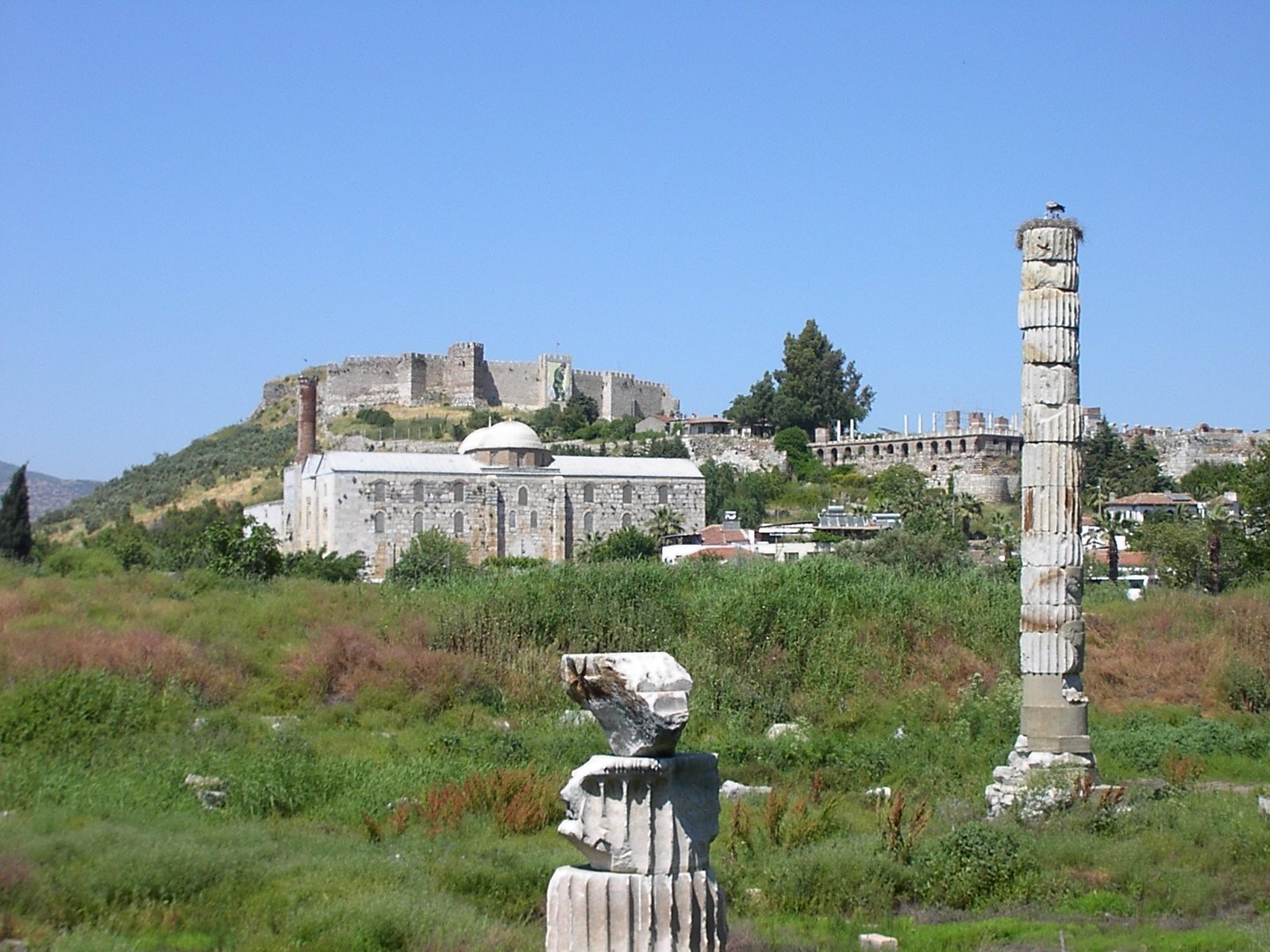
Temple of Artemis (or Diana). This massive temple was one of the 7 Wonders of the Ancient World, built for the virgin goddess of fertility (echoes of Mary!) First built in 550 BC & rebuilt 3x until 401 AD, this model shows how it looked -- 450' by 225' by 60' high, with 127 columns
Today, there is one single column reconstructed onsite.


On Ayasoluk Hill beyond are a Seljuk mosque & Ottoman castle.

Here were all 3 periods of history: Temple column, mosque & castle.
These geese were a different wildlife than we had seen on this trip.


We saw how transitory is the majesty of Ephesus & other physical monuments now in ruins. Only personal relations, knowledge & experience endure.
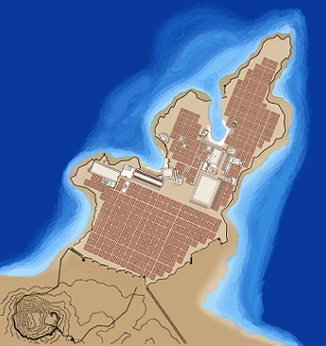
Miletus. Named for a city in Crete, this was settled by Cretans in the 1300's BC on a spectacular Aegean peninsula. It became a wealthy trading center, then a Greek center of science & philosophy after 500 BC. Hippodamus laid out streets in a grid pattern during the 5th century. Its popul. peaked (about 200,000) in Roman times, but the city later faded when the Meander River silted up the harbor. It is now 6 miles inland.
The Theatre. Only about 1/2 restored, it once seated about 15,000.


Roman Baths. Established under Marcus Aurelius (160 - 180 AD), this was the largest bath and sports complex in Roman times.

Great Harbor Monument. This Roman structure (1st cent. BC) was one of its most distinctive features -- now reconstructed from preserved parts.


Paul's Farewell. Here on these same steps, while ending his 3rd journey, Paul met with "elders of the church." He "hasted to be at Jerusalem for Pentecost, not knowing the things that shall befall [him] there." He warmly spoke of his labors to them "night & day, with tears." He warned them that "grievous wolves" among them may "draw away disciples after them." He quoted Jesus as saying: "It is more blessed to give than to receive." Then he knelt in prayer with them & tearfully bade farewell, saying they "shall see my face no more" (Acts 20:16-38).
On reaching our lodging, Rachel and Devin had a "long hair" contest. It looked like Devin won -- but Courtney's red hair was even longer.

Day 6 (9/23/11) -- Pamukkale, Hierapolis, 7 Churches of Asia, Bursa
A big surprise awaited us that day, as we left the coast & turned inland for the rest of our field trip. First stop was for these white cliffs & hot springs:
Pamukkale (Turkish: "cotton castle") Here were 400 acres of travertine terraces formed by ongoing deposits of calcium carbonate ("baking soda").
The deposits came from 17 very hot springs (95 to 212 F) caused by underground volcanic activity.


Soft as gel, these deposits soon harden into stone. Some are like stalagmites.
Wading was only permitted in bare feet. No shoes allowed.


These springs flowed over terraces into blue-water pools below.


The scenery was Swiss Alps, the weather was California!

Hierapolis (Greek: 'holy city"). This was built atop the hot springs by Romans in 200 BC as a healing & trading center. It became wealthy and prominent in the arts & philosophy. Up to 100K lived here; but it was destroyed by earthquakes in 17, 60 & 1354 and by Persia after 600 AD. Today, only ruins remain.


The Theatre. This arena (capacity 15K) was used for performances & contests.

It had the best-preserved stage & seating areas of any theatre in ancient Turkey, as explained by Fatih -- our excellent guide from Istanbul.

The Necropolis (cemetery). Beyond the city walls & meadow, in all directions, is the largest, oldest & best preserved graveyard in ancient Turkey.


There were simple tombs carved into rock for poor families. The most elaborate were subterranean "tumulus" chambers down flights of stairs covered by travertine slabs & earthen cones -- for the very wealthy. Some had a phallic symbol placed on top, denoting family fertility and continuity.

Other subterranean tombs were covered with monumental stones.


Many were above ground in simple or elaborate sarcophagi.


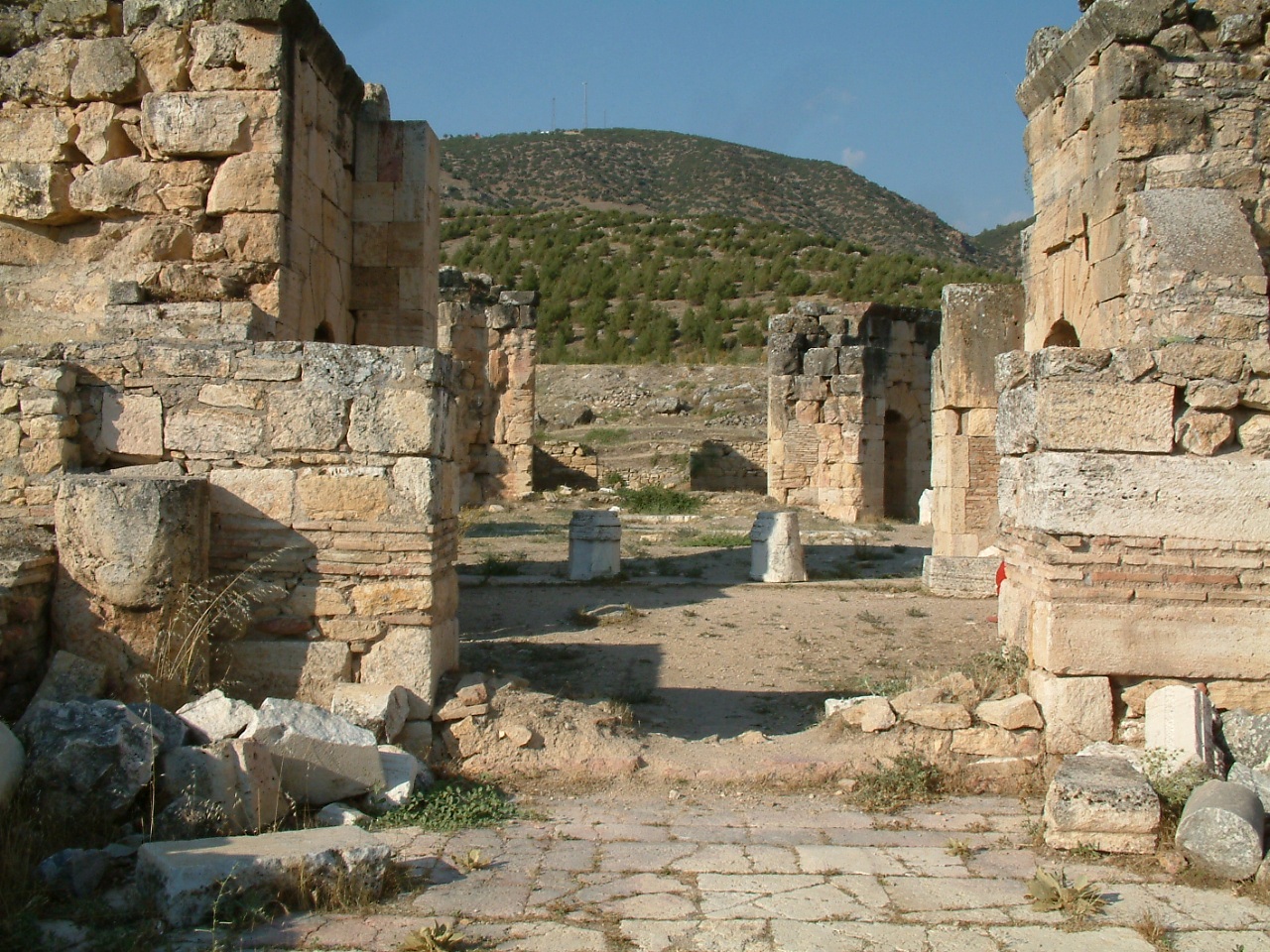
Martyrium. This was built over the possible tomb of apostle Philip, killed here by the Romans about 80 AD by upside-down crucifixion or hanging. Destroyed by earthquake after 650 AD, this elaborate octagonal marble Byzantine bldg. once had 28 small square rooms under a lead-covered wooden dome.
In August 2011, an Italian archaeologist announced discovery of the actual tomb of St. Philip within this 5th century Byzantine church.
Gates & streets. The main mile-long street with colonades ran along the sacred white travertine terraces & springs, with monumental gates at both ends. Other streets ran from that one in a perpendicular grid pattern.


It was hard to leave this beautiful place. There was so much to see there. But we had a long bus ride ahead.


The 7 Churches of "Asia" (a Roman province, not the continent).
St. John's apocalyptic Book of Revelation (written in exile on the isle of Patmos) begins with the Lord himself instructing John to write separate letters to each of the 7 existing branches of his church in "Asia" (all today in Turkey). Each starts with a little praise, followed by some warnings, curses & promises. Like John's gospel, Bro. Skinner believes this book was also written for endowed saints.
Laodicea. The closest one to Hieropolis (6 miles), near modern Denizli, this important Roman commercial center was named for a Greek king's wife (about 260 BC). It had a renowned medical school. Many Jewish settlers came there after liberation from Babylon.
John famously warned the saints not to be lukewarm -- "neither hot nor cold" -- lest the Lord "will spue thee out of [his] mouth" (Rev. 3:16). This was dramatic imagery, as Laodicea was sited part way between the hot springs of Hieropolis & the cold mtn. streams of Colossae in the opposite direction.
Philadelphia. We didn't detour to visit this site in the mtns., above modern Alasehir. Perhaps because this city was the only one not warned or cursed by the Lord, Wm. Penn took its name for his capital in PA. Also, he yearned for it to be a "holy city, new Jerusalem, coming down from...heaven" (Rev. 21:1). John used temple imagery, like "a pillar in the temple" and a "new name" (Rev. 3:7-13).
Thyatira. We did stop there -- now called Akhisar. It was home to many pagan trade guilds. Lydia, the early Christian wealthy benefactor, sold royal purple dye & textiles there. John's longest letter was written to those saints. Jesus strongly condemned the saints' eating of food sacrificed to idols at guild banquets in Roman temples & sexual immorality that followed (Rev. 2:20). But he ended with some sacred imagery of the "rod of iron" and "morning star" (2:27-28).
Near the town center, we (and some creative students) entered an ancient basilica & agora that was excavated in the 1970s.


Across the street from the ruins were some interesting sights.


Ephesus. John's 1st letter was written to the saints at mighty Ephesus, which we visited the prior day. He had some strong words for them (Rev. 2:1-6), but promised: "To him that overcometh will I give to eat of the tree of life, which is in the midst of the paradise of God" (2:7). In Mormon theology, this is the pure love of God & gift of eternal life (1 Ne. 11:21-23).
Smyrna. This city was further up the coast -- between Ephesus & Pergamon. Today, it is the major city of Izmir. He warned them of coming tribulation but promised those "faithful unto death...a crown of life" (Rev. 2:10).
Pergamon. Here we had the lightning storm two days earlier. The Lord strongly condemned "Satan's seat" & many false doctrines there. But he also provided more sacred imagery, promising "hidden manna," "a white stone" and "a new name" to those that overcome (Rev. 2:17).
The longest bus ride of our trip continued, interspersed with an infrequent stop. (We both look better awake than asleep.)


Many crops grew in fertile valleys, ringed with picturesque mountains. Turkey wasn't as brown as I had thought it would be.


We ended our longest rides of the trip at a 5-star Hotel Almera in Bursa. Our room was spacious and meals were sumptuous.


The bottom level had a heated pool and spa.


We slept well that night.

Day 7 (9/23/11) -- Bursa to Nicea to Istanbul to the JC.
Bursa borders the Sea of Marmara on one side (NW) & steep, often snowy Mt. Uludag on the other (SE). Before capturing Constantinople in 1453, the expanding Ottoman Empire made Bursa its 1st capital in 1326. It is now the 4th largest & 3rd most important economic center in Turkey.
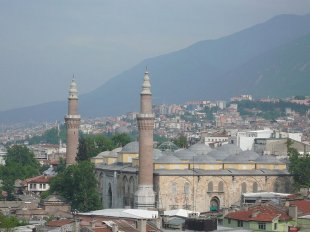
The Great Mosque. Bursa has the largest mosque in Turkey, built in 1400 AD. When Sultan Bayezid I won the Battle of Necopolis, instead of building 20 mosques as he had promised, he built an oversized one -- with 20 domes.
These domes are in 4 rows of 5, supported by 12 columns. This subdivision of space with multiple domes and pillars creates a greater sense of privacy.


Each column is inscribed with monumental Islamic calligraphy, also seen on walls and plates. It may be the best in the world.

In the center is an ablution fountain for ritual washing of head (face, nose, mouth, ears), hands and feet. This is also done (usually with soap) after marital intimacy & bowel movements. The overhead skylight is its most beautiful, admitting soft light that serenely augments the illumination.


Female students covered their heads with scarves, as did Marilyn & Arlene.


We had renewed respect for Islamic devotion & some similarities to LDS temples.
Nicaea [Greek = Neikaia]. Not far from Bursa is this historic town, today called Iznik (population 15,000). It was named for the wife of a Greek ruler (Lysimachus) in 301 BC. She was also the daughter of Antipater, close ally of Alexander the Great. Nicaea, like Nice of France, may have come from Nike -- the Greek goddess of Victory.

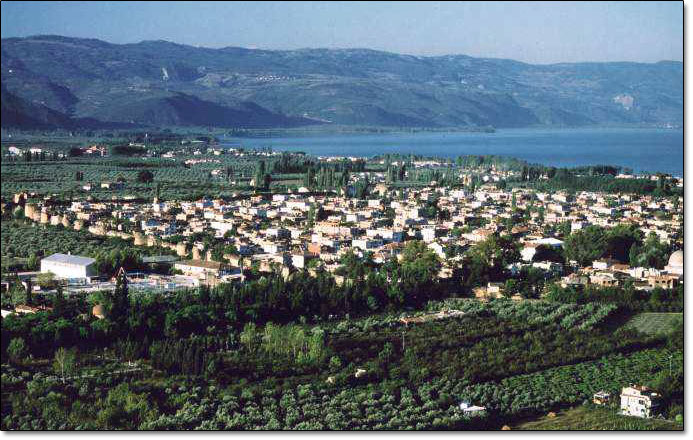
Ringed with mtns., Nicea is still situated on the eastern shore of large & scenic Lake Iznik -- over 12 miles long, with a surface area of 175 miles. The lake is 6 miles from the Sea of Marmara -- either due west or due north.
Nicea was -- and Iznik still is -- famous for its pottery & tile work. Over the centuries, elegant tiles were used for Istanbul's great Hagia Sophia church.
Our ride along the lake shore had some gorgeous views on a clear day. 


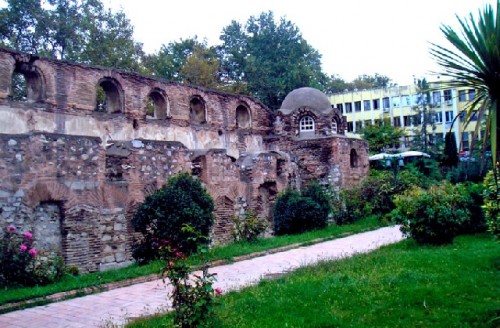
Anciently, the city was bounded on all sides by 3 miles of high walls. These included 4 gates & many towers. Today these ruins add charm to Nicea's importance in early Christian history.

In 325 AD, Roman Emperor Constantine convened the 1st Council of Nicea. Prelates from all over the Roman Empire debated the trinity's nature & issued the Nicene Creed. That council was likely held in a church now under Lake Iznik. The 2nd Nicean Council in 787 AD (to resolve the use of religious icons) was convened in Nicea's Hagia Sophia Church.


Like its larger namesake in Istanbul (also built by Justinian I), this Byzantine church became a mosque before it became a museum about 1997.


We were asked not to sing Christian hymns here, perhaps due to concern that it may again be claimed as a Christian place of worship.


Instead, we met and sang beside beautiful Lake Iznik.


There, Fatih 1st spoke historically of the Muslim conquests (by Seljuk Turks in 1078 and Ottomans in 1453). Then Dr. Huntsman & Skinner spoke of Christian doctrinal developments at the Nicene Creed. Finally, Dr. Harper told how Joseph Smith clarified the true nature of the Godhead thru modern revelation.


The Bentleys & Chapmans greatly enjoyed everything -- together, this time. (Dr. Chapman & Arlene always rode on the other bus from ours.)

Istanbul. Before sunset, we ferried back across the Sea of Marmara.


Istanbul at rush hour was slow going. We saw both modern and ancient bldgs.


Our afternoon time was spent at Hagia Sophia. [See Sept. post, Turkey -- Istanbul.] We said farewell to Fatih, our favorite local guide.


Before flying back to Jerusalem, we visited the nearby Arasta Bazaar. We saved any buying for our last days in Jerusalem.


Time to take our bus to Ataturk Airport and Turkish Air. Unlike our 9/19/11 flight to Istanbul, this one back to Jerusalem was far less comfortable. We also waited over an hour on the tarmac and finally got to bed by 4 am.


Both we and the students loved this field trip -- but were very happy to return.


No comments:
Post a Comment